Showing posts with label First Nations. Show all posts

Wednesday, 11 December 2024

The Residential Schools: were they schools?


"Residential schools (in Canada) did not arise from a well-meant initiative run amok. Even the most basic research reveals the destructive intent at the foundation of their design and implementation. They were not schools. They were institutions akin to the re-education centres of the Cultural Revolution in China and its current re-programming camps where ethnic Uyghurs are detained."

    - Michelle Good in "Truth Telling"

This truth needs to be repeated insistently until reconciliation moves beyond hand-wringing words - to action - specifically the 94 Calls to Action of the Truth and Reconciliation Commission in 2015.

The Truth and Reconciliation Commission (TRC) of Canada issued 94 Calls to Action, several of which are directed specifically to the Catholic Church. Here are the key ones that apply to the Catholic Church:

1. Call to Action 58: The TRC calls upon the Pope to issue an apology to Survivors, their families, and communities for the Roman Catholic Church's role in the spiritual, cultural, emotional, physical, and sexual abuse of First Nations, Inuit, and Métis children in Catholic-run residential schools.

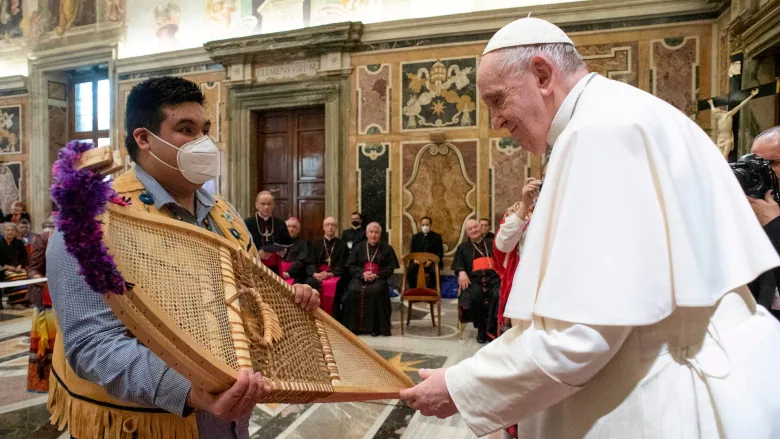
- Pope Francis came to Canada in the summer of 2022 and gave an apology. Some feel that it was just an apology for what "some" Catholics did historically, not an apology for what the Catholic Church did in facilitating and promoting colonial hegemony. Still, it was a well-intentioned start that was accepted by some Indigenous leaders.

2. Call to Action 59: This call asks church parties to the Settlement Agreement to develop ongoing education strategies to ensure that their congregations learn about their church's role in colonization, the history and legacy of residential schools, and why apologies to former residential school students, their families, and communities were necessary.

- There has been no effective action on this whatsoever. At the very least there could be an Indigenous Land Acknowledgement before Sunday mass in every parish church in every diocese in Canada. 

3. Call to Action 60: The TRC calls upon leaders of the church parties to the Settlement Agreement and all other faiths, in collaboration with Indigenous spiritual leaders, Survivors, schools of theology, seminaries, and other religious training centers, to develop and teach curriculum for all student clergy, and all clergy and staff who work in Aboriginal communities, on the need to respect Indigenous spirituality in its own right, the history and legacy of residential schools, and the roles of the church parties in that system.

- Very few priests and deacons would appear to have even heard of the Doctrine of Discovery, even young priests fresh out of seminary. Catholic priests are largely ignorant of Indigenous spirituality, the history and legacy of residential schools, and the roles of the church parties in that system. On the contrary, much of what we hear is more defensive in nature or, at best, verbal hand-wringing devoid of acknowledging actual historical facts with present-day repercussions.

4. Call to Action 61: This call asks church parties to the Settlement Agreement, in collaboration with Survivors and representatives of Aboriginal organizations, to establish permanent funding to Aboriginal people for community-controlled healing and reconciliation projects.

- There has been some movement here in many dioceses, dependent upon donations to the Indigenous Reconciliation Fund. Most Catholics in the pew view their donations to this fund as charity, or in the same category as funds needed to pay victims of clergy sexual abuse.

These Calls to Action aim to address the historical injustices, and promote healing and reconciliation between the Catholic Church and Indigenous communities in Canada. It's time for a lot more concrete and effective action in response to the calls of the TRC made way back on the 15th December 2015.

Friday, 21 June 2024

National Indigenous Peoples Day


June 21: National Indigenous Peoples Day. How much do you know of the Indigenous history of the place where you live, or where you work?
It was only last year that I learnt that we are all treaty people, and only this year that I learnt that the treaties are not deeds of sale. I highly recommend a book by Bob Joseph: 21 Things You May Not Know About the Indian Act.

Sunday, 1 October 2023

Orange Shirt Day - and Silence

Every word has consequences. Every silence, too. - Sartre


September 30th was Orange Shirt Day in Canada. On this day Indigenous people were remembering the cultural genocide and abuse that took place in the Indian Residential Schools that were operated by Catholic and other Christian denominations on behalf of the Government of Canada to "take the Indian out of the child.” (Sir John A. Macdonald)

At an Orange Shirt Day event in downtown Peterborough on Saturday, one of the organizers acknowledged the presence of some civic and political leaders, and police officers, who came, not to speak, but to listen. To my mind, that is a good silence, a silence that begets good consequences.

I was also aware of the conspicuous absence of any mention of representatives from Christian churches in Peterborough, notably for me, the Catholic Church. That silence was deafening - and severely consequential.

Saturday, 23 July 2022

Anticipated Papal Apology - Canada 2022


Image credit: https://i.cbc.ca

Different people have emphasised different elements and narratives if the coming, long awaited apology from Pope Francis this month of July, 2022, is to have any hope of acceptance from Indigenous Peoples in Canada, and especially from survivors and others impacted by forced residential schooling which the Catholic Church so enthusiastically and vigorously implemented on behalf of the Canadian Government in the nineteenth and twentieth centuries; even before we get to recalling the sexual and other abuses that went on for so long and were covered up by complicit hierarchy for decade after decade.

The 'apology' will surely be comprised of the entire pontifical visit, from landing to takeoff, and not just the 'words of institution', as it were.

I am of the opinion that the Catholic residential schools debacle is just one, albeit a very major one, of many 'sins' for which the Catholic Church needs to publicly repent. Consider all the unjust wars, slavery, persecutions, murders, rapes, pillage, theft and imperialistic colonizing that took place subsequent to, and enabled and condoned by what is now called The Doctrine of Discovery. If you don't know what this is, or to refresh your memory, please see this one or two minute read: https://doctrineofdiscovery.org/dum-diversas/

For those who think that sincere and humble words should be enough, consider the following story from Father Mxolisi Mpambani told by Antjie Krog in Chapter 10 of her book, Country of my Skull, which deals with the South African Truth and Reconciliation Commission post apartheid.

Once there were two boys, Tom and Bernard. Tom lived right opposite Bernard. One day Tom stole Bernard's bicycle and every day Bernard saw Tom cycling to school on it. After a year, Tom went up to Bernard, stretched out his hand and said, "Let us reconcile and put the past behind us."

Bernard looked at Tom's hand. "And what about the bicycle?"

"No," said Tom, "I'm not talking about the bicycle - I'm talking about reconciliation."


True reconciliation requires remorse, repentance, restitution, reparation, reform, unbounded respect, and acceptance of the fact that forgiveness might still not be forthcoming in our lifetime.

Tuesday, 26 November 2019

Raw Sewage in Canadian Rivers


So, here is my question: Are there or are there not provincial or federal laws or regulations prohibiting the release of  commercial and industrial waste and, especially, raw sewage into the rivers of Canada or, at least, the rivers and aquifers of Ontario?

If not, why not? If yes, how are they enforced?

I ask after being shocked to read the following article in Global News:
Oneida Nation of the Thames tap water different than neighbouring non-Indigenous communities

Particularly disturbing are the following three paragraphs:

"18 years of water quality testing across Oneida First Nation sometimes shows striking levels of dangerous pathogens such as E. coli flowing from residential taps. Upstream, the nearby city of London dumps millions of litres of raw sewage into the Thames River that serves as the community’s water source…"

"The Thames River, which replenishes Oneida’s aquifer, is a dumping ground for waste, raw sewage and pollution. To avoid basement flooding during heavy rains, London’s wastewater system dumps rainwater and raw sewage into the river. In 2018, 266 million litres of raw sewage was released and flowed downstream through several First Nations communities, including Oneida.

"So far this year, more than 5.7 million litres of London’s raw, untreated sewage — including commercial and industrial waste — has been dumped into the river, according to city data.
London didn’t start notifying Oneida of sewage dumps until mid-2018, say Oneida leaders, including Chief Hill. Even then, Oneida is only notified after the dump has occurred, sometimes hours or days later."

Here, again, is my question: Are there or are there not provincial or federal laws or regulations prohibiting the release of  commercial and industrial waste and, especially, raw sewage into the rivers of Canada or, at least, the rivers and aquifers of Ontario?

If not, why not? If yes, how are they enforced?

I realise that the question is rhetorical. Doing just 2 minutes of searching on the Internet I found that:
  • raw sewage overflowed into southern Ontario waterways 1,327 times in the 12 months ending March, 2018;
  • the city of Toronto releases more than 1-billion litres of raw sewage into Lake Ontario in a single day;
  • when excessive stormwater has nowhere to escape, it funnels into sewers causing them to overflow and spill untreated contents into lakes or rivers;
  • there are provincial regulations but they are full of loopholes circumventing enforcement.

I have been following a Facebook group focusing on drinking water and other water availability issues in South Africa. They regularly bemoan the fact that, due to aging infrastructure, neglect and poor accountability, raw sewage is spilling into some of the dams sourced for drinking water. I have been feeling lucky to be living in Canada - a First World country after all. How presumptuous and arrogant of me.

Thursday, 31 October 2019

Learning the Land: Walking the talk of Indigenous Land acknowledgements

Learning the Land: Walking the talk of Indigenous Land acknowledgements


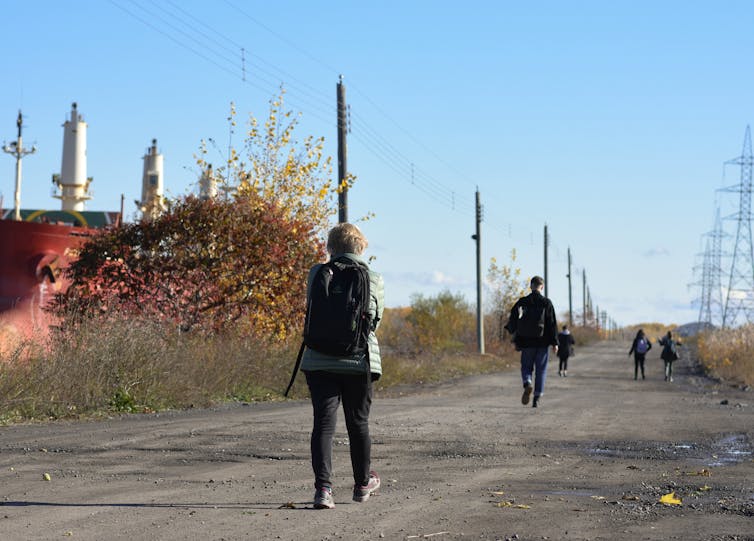
Indigenous activists have drawn attention to threatened waterways, neglected Residential School cemeteries and other social issues by walking across Land. Here a group of settlers on an Indigenous Land acknowledgment pilgrimage. Laurence Brisson/The Concordian, Author provided
Matthew Robert Anderson, Concordia University
University, religious, sports and other gatherings often begin with an Indigenous Land acknowledgement. For instance, this article was written in Montréal, or Tiohtiá:ke, on the traditional and unceded territory of the Kanien’kehá:ka (Mohawk), a place which has long served as a site of meeting and exchange amongst nations.
Land acknowledgements recognize what for some Canadians is an uncomfortable truth. These are formal statements that recognize “the unique and enduring relationship that exists between Indigenous Peoples and their traditional territories.”
On Land where territorial treaties were negotiated, the acknowledgement may use the term “traditional Lands,” and go on to specify the treaty and its number (Treaty 4, for example, includes much of southern Saskatchewan.) Land is so important that Gregory Younging — scholar, editor and author of the copyeditor’s book Indigenous Style — insisted Land be capitalized.
But when governmental and business meetings are far less likely to include acknowledgements of Indigenous Land titles, or when artistic and educational events move from initial statements to silence about their political and economic ramifications, it is hard to avoid the conclusion that such recognition is simply lip service.
What do groups mean when they say they recognize Indigenous presence, resilience and Land? And how can settler groups begin to walk the talk?
In 21 Things You Should Know About the Indian Act, author and president of Indigenous Corporate Training Bob Joseph urges Canadians to physically get out and get to know local First Nations. Ways to do this include attending Indigenous cultural or sports events or using Indigenous businesses.
As a settler academic who grew up on Treaty 4 territory, I have benefited from years of Indigenous guidance in ally-building in journey/pilgrimage studies, biblical studies and Land access. Following these learnings, I believe it is time for those of us who are not Indigenous to let our bodies learn about acknowledgement, sometimes by literally walking the talk.
Properly prepared “walking acknowledgements” are one way for those of us who are non-Indigenous to demonstrate that we mean what we say about unceded and traditional territories.

Location, location, location

It is by walking across Land that Indigenous activists have drawn attention and acknowledgement to waterways threatened by overuse or pollution, residential school cemeteries that have been neglected or abandoned, issues of justice for northern communities and, with displays of vamps (moccasin tops), Missing and Murdered Indigenous Women and Girls.
Margaret Kovach, Linda Tuhiwai Smith and other Indigenous academics consistently use the physical language of “grounding” and “place” to explain how one learns within Indigenous knowledge systems. They argue that Indigenous ways of knowing require the bodily recognition of one’s relationship to Creation and to others.
One of the first and most influential of Indigenous scholars addressing western research methods and Indigenous cultures, Māori professor of Indigenous education Tuhiwai Smith points out that it is always specific Land that gives meaning to Indigenous stories, ceremonies and history. Kovach adds that “self-location anchors knowledge within experiences.”

Understanding relationships to Land

This month, I led 11 students, faculty and friends on a 26-kilometre walk from Kahnawà:ke to the Department of Theological Studies at Concordia University, in Montréal, as a Territorial Acknowledgement for our Theology in the City conference. Walking helped us put our bodies where our mouths are. Those who have undertaken walking Land acknowledgements say it has both educated them and moved them away from political inaction and neutrality.

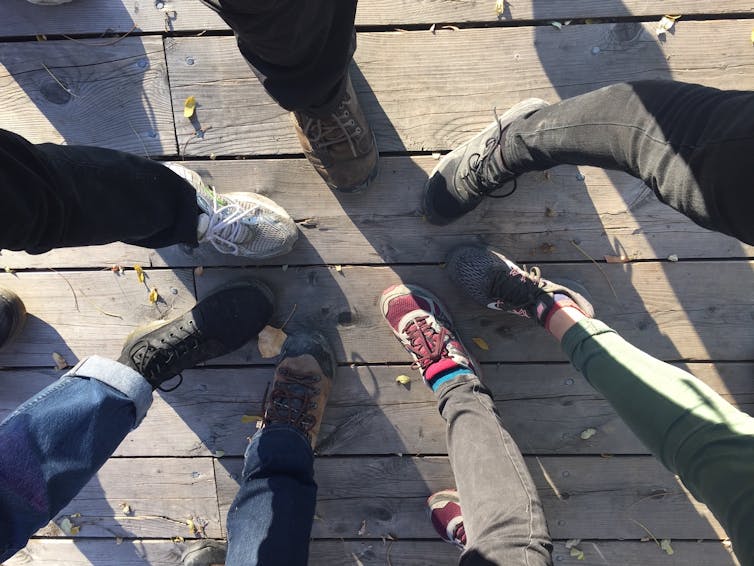
A pilgrim walk to help participants understand the true meaning of Indigenous Land acknowledgements took place last weekend in Montréal. Matthew Robert Anderson, Author provided

Showing up uninvited or unannounced is not acknowledgement. It risks being another colonial act. But with Indigenous guidance, we can physically get to know the Lands and people we are acknowledging.
These experiences help settler North Americans experience the locality and relationships that underlie most Indigenous understandings of Land. Getting to know the Land helps us learn its history — including its histories of colonization and of Indigenous resurgence.
Beginning in 2014, with the guidance and permission of the Mohawk Cultural Centre of Kahnawà:ke, and the Mohawk Nation at Kahnawà:ke Longhouse, professor of theology Sara Terreault and I have led groups of students from Concordia University on four annual pilgrimages.
We walked about 32 kilometres between Old Montréal, where the first French colonists built their churches and homes, and Kahnawà:ke Mohawk Territory. Some of our students had visited Kahnawà:ke before; some grew up in adjacent communities. Consistently, they reported in their project evaluations that walking the St. Lawrence Seaway, built in part on bulldozed Mohawk homes, and physically experiencing the contested border areas, and the First Nation, brought them new understandings of colonialism, economic injustice and histories of both oppression and resurgence.
Atsenhaién:ton Kenneth Deer, the secretary of the Mohawk Nation at Kahnawà:ke and a working group member of the United Nations Declaration on the Rights of Indigenous Peoples, assisted us on our walk and said:
“By walking from Concordia to Kahnawà:ke or from Kahnawà:ke to Montréal you can see how close we are but a world apart.”
U.S. anthropologist Chip Colwell notes that despite the risk of token gestures, repeating Land acknowledgements offers us a chance “to confront the past while laying the groundwork for building a shared future.”
Walking through such statements helps us remember that they are both real and political, and based on Indigenous assertions of title to real places.
Acknowledgements spur us to recognize not only Land, but also commitments made in the treaties, in the United Nations Declaration on the Rights of Indigenous Peoples, or in Canada’s Truth and Reconciliation Commission’s 94 Calls to Action.
Walking all, or some part of, our Land acknowledgements gets settlers out of their silos. It can help groups experience first-hand the Land, the relationships and the Indigenous Peoples of which the Land acknowledgements speak.
But walking Land acknowledgements are only first steps toward education and consciousness-raising. They are part of the process of non-Indigenous people becoming allies through Indigenous pedagogies. Only when Land acknowledgements are fully lived out — that is, when they deepen into meaningful economic, political and cultural change, will we really be walking in the true direction of reconciliation.
[ Deep knowledge, daily. Sign up for The Conversation’s newsletter. ]The Conversation
Matthew Robert Anderson, Affiliate Professor, Theological Studies, Loyola College for Diversity & Sustainability; Honorary Research Fellow, University of Nottingham UK, Concordia University
This article is republished from The Conversation under a Creative Commons license. Read the original article.

Monday, 7 December 2015

Indonesia is burning. Who cares?

Fires in Indonesia are currently producing more carbon dioxide than the US economy. And in three weeks the fires have released more CO2 than the annual emissions of Germany.

Photo: Ulet Ifansasti/Getty Images via www.theguardian.com.
Starbucks, PepsiCo, Kraft Heinz and Unilever are complicit in both cause and inaction.

The cost in human lives and misery is colossal as is the destruction of species. ‘Children are being prepared for evacuation in warships; already some have choked to death. Species are going up in smoke at an untold rate.’

This article was written October 30 and revised November 16. The fires continue unabated.


Indonesia is burning. So why is the world looking away?

by George Monbiot in The Guardian.

Thursday, 3 September 2015

Poverty in Canada

Just in time for the election campaign, the Canadian Conference of Catholic Bishops (CCCB) has published a new resource document titled,  A Church Seeking Justice: The Challenge of Pope Francis to the Church in Canada.
Here is an excerpt from paragraph 25.


Canada is a wealthy country, yet has an ever widening gap between rich and poor. 4.8 million Canadians live in poverty, including 1 million children. In 1989, all parliamentarians committed to ending child poverty in Canada. Today, 1 in 7 children lives this reality, with 4 in 10 Indigenous children living in poverty. Current levels of poverty cost us billions of dollars in terms of increased health and social services costs and severely damage the fabric of our society as a whole. Why does a wealthy country like Canada not dedicate more of its resources to reducing poverty? Provinces like Quebec and Newfoundland and Labrador have adopted poverty reduction plans; should we not have a national poverty reduction strategy?


 An important point here is that there is a cost to poverty. You pay to eliminate it or you pay not to!

A Church Seeking Justice: The Challenge of Pope Francis to the Church in Canada. The Episcopal Commission for Justice and Peace of the Canadian Conference of Catholic Bishops. 2015. Para. 25.


Monday, 24 August 2015

Sssh! Single Issue Voting Not Encouraged By Canadian Catholic Bishops

One of the problems bedevilling many elections is the phenomenon of 'single issue' voters. The issue is usually a very worthy one such as 'healthcare' or 'care for seniors' or 'right to life for the unborn' or 'education' or 'immigration' or 'jobs' or 'the environment' or 'higher/lower taxes' or 'crime and punishment' or 'national security' or (your pet issue here). The trouble is that real life is never about one single issue even if that appears to be front and centre at a point in time for you and me.

It seems to me that voting on the basis of a single issue is very much like choosing a particular expensive gourmet restaurant over other candidate restaurants based purely on the fact that the restaurant of your choice is the only one that offers Pacific Blue Fin Tuna in its third course, and without regard to what is in the other courses at that or any other competing restaurant. Don't you care that your Valentine partner will have ethical issues with Confit Foie Gras? It seems silly, doesn't it? But isn't that what single issue voters do? I've had emails from well-meaning friends urging me to join this or that political party and then vote for this or that person to be leader of that party because he/she is the 'only one' taking a stand on a pet, controversial issue.

Contrary to what many people might presume, the Canadian Catholic bishops are not single issue voters. I know this because I have read their Guide for the 2015 Federal Election. As with previous federal elections the Canadian Conference of Catholic Bishops has issued an 'Election Guide' for Catholics. I get the impression that it is meant to be kept a secret as I never hear anybody talk about it and no priest of my experience has ever mentioned it, privately or publicly, in my hearing. If it was not for the fact that I have an email subscription for new publications from the bishops' conference I myself would have no idea of its existence.


The email begins: (CCCB – Ottawa)... With the federal election campaign underway, the Commission for Justice and Peace of the Canadian Conference of Catholic Bishops (CCCB) has issued a guide inviting Catholics to vote with discernment. In its "2015 Federal Election Guide", the Commission lists some basic principles from Catholic moral and social teaching to help voters analyze and evaluate public policies and programs.

It then provides this link to their web page titled Guide for the 2015 Federal Election.
http://www.cccb.ca/site/eng/media-room/4243-guide-for-2015-federal-election

How incredibly circumspect, inviting Catholics to vote with discernment, Obviously the bishops do not want to alienate anybody by being forceful in any kind of way about Catholic moral and social teaching! The web page in turn provides three more links which I reproduce below for your convenience and invite my family and friends to read with discernment - and anybody else who cares to. I expect you will find, like me, that none of our political parties measures up. Sometimes the way to find the best is find the least worst.
Link to the Guide of the CCCB (PDF)
Link to the Guide of Development and Peace
Link to the Guide of The Canadian Council of Churches

Saturday, 1 September 2012

Enbridge Northern Gateway, Eh?


For any tl;dr readers, just look at the yellow highlight.

This is the record of submission by Elizabeth May on Friday, 31 August, 2012 to the Enbridge Northern Gateway Project Joint Review Panel. You can click on the above link or just read it below. I did not see any notice of copyright and I doubt that there is one; it is a public submission.

This should be considered required reading for anyone who has any interest in the pipeline but, more especially, for Canadians with no interest in it or who do not care one way or another.

I have taken the liberty of adding yellow highlight to salient points for the sake of people who do not want to read every last word of Elizabeth's submission but want to know the gist.


Submission to the Enbridge Northern Gateway Project Joint Review Panel
On Friday, August 31st, 2012

As leader of the Green Party of Canada and as the Member of Parliament for Saanich-Gulf Islands, I appreciate this opportunity to place on the written record my comments on the Enbridge proposal for a 1177 kilometre long, twinned pipeline across northern British Columbia and a port at Kitimat to receive diluents and pipe it to Alberta, while piping back to Kitimat the mixture of diluents and bitumen.  The proposal further involves the shipping of this mixture by super-tankers to be operated by persons unknown to, as yet undisclosed, ports.
Having observed the hearings and the evidence over the nearly eight months since the hearings began, I wish to make the following observations: 
  1. The proponent, Enbridge, has failed to provide any specific information about the impact of spills, on land or at sea, of the mixture it proposes to move by pipeline and sell to other carriers for shipment by sea.  Bitumen and diluents were shown in the Kalamazoo Michigan spill to be considerably more difficult to remediate than conventional crude.  The proponent has now admitted all its evidence was based on a substance it is not proposing to ship.  Meanwhile, it should be noted that few improvements or technological advances on handling spills of conventional crude have been made since the Exxon Valdez spill.
  1.  The proponent has violated its social licence to operate through a culture of negligence. This failing is well-documented in the report of the United States National Transportation Safety Board  (Enbridge Incorporated, Hazardous Liquid Pipeline Rupture and Release, Marshall Michigan, July 25, 2010, Accident Report NTSB/PAR-12/01, PB2012-916501, July 10, 2012).  The spills and pipeline leaks in Kalamazoo, Michigan in 2010 and additional spill in the summer of 2012 in Wisconsin are ample evidence of the corporate culture of Enbridge being negligent. The panel is commended for accepting the report of the US. NTSB into evidence.  As evidence before this panel, the litany of failures in preventing the Kalamazoo spill and subsequent negligence in ignoring alarms and pumping more bitumen-diluent mix into a broken pipeline must lead to a rejection of this proposal at this time.
  1.  The July 2012 report of the US NTSB is also relevant as it is clear that the Enbridge proposal was developed without any consideration of the experience of the serious spill in 2010 in Michigan.  As such, the current proposal should be rejected and the proponent instructed to revise any proposal to take into account lessons learned in the 2010 failure.
  1. The proponent has offered to this panel a mathematical risk estimate for spills in which the proponent deliberately chose to exclude local spill and accident events in the waters in which the proponent proposes to operate. This evidence of dramatically under-estimated risk of accident should be entirely discounted as fanciful and absurd.  The review of this mathematical alchemy by the Raincoast Conservation Foundation should be accepted instead.
  1. The need for the additional pipeline capacity has not been established.  On this point, the evidence of J. David Hughes should be accepted that unless and until bitumen production increases by 150% from current levels, the existing pipeline infrastructure is adequate. (“The Northern Gateway Pipeline: An Affront to the Public Interest and Long Term Energy Security of Canadians,” November 22, 2011).
  2. Transport Canada’s submission to this panel was reported in the media as establishing that there was no serious risk in super-tanker traffic. In fact, it did not say that at all.  It merely said there were no “regulatory gaps.”  In other words, it said, if there is a spill, we know which department will be in charge. In the entire Transport Canada review, there is no specific assessment of the particularly turbulent and navigationally challenging passages any super-tanker would encounter. The words “Hecate Strait” do not appear in the Transport Canada review, even though, Environment Canada’s Marine Weather Hazards Manual states that the Hecate Strait is “the fourth most dangerous body of water in the world.” The Transport Canada submission should not be used in evidence as relevant to the specific risks of the British Columbia coast. 
  3. No federal body nor the proponent have come forward with any credible analysis to lift the 1972 moratorium, honoured by every federal and British Columbia government since that time. It banned super-tanker traffic along the BC coastline, with the Port of Vancouver grandfathered.  The federal government and the proponent would like to “pretend” the moratorium away.  Admittedly, the moratorium was not enshrined in law, but its observance for four decades is a significant statement about its existence and importance. This panel has an obligation to consider Enbridge’s proposal as one that has the burden of proof to lift an existing moratorium.    
  4. The increased tanker traffic has been found to be a source of significantly increased risk to the endangered whales in the area. Department of Fisheries and Oceans (DFO) review of threats to humpback whales in 2005 named the proposed tanker traffic to Kitimat as a threat to whale recovery.  Humpback whales are listed as a species at risk in the threatened category.  Scientists actually think the fin whales may be even more at risk of tanker collisions. Proposed mitigation measures of whale spotters on board tankers are mere “window dressing.” The notion that whale spotters can avoid collisions with endangered whales would only be plausible if super-tankers were prohibited from travelling at night, in dense fogs (typical in the area) or in storms and gales (also typical in the area).
  1. First Nations constitutionally protected rights have not been honoured by the proponent.  The proponent made false claims about the extent of its relationship with the Haida Nation, according to a letter sent to this panel by the President of the Council of the Haida Nation last year.  The timelines and deadlines for this panel’s work will be unlikely to survive a court challenge under many precedents of the requirement for consultation and for the federal government’s fiduciary obligations to First Nations.
  1. Dr. Jeffrey Hutchins of Dalhousie University has drawn attention to the fact that the Department of Fisheries and Oceans was unable to provide the detailed scientific information this panel requires to make any judgement about the extent of damage to ecosystems and fisheries in the hundreds of stream and water crossings the pipeline will entail.  It is outrageous that a government agency would conclude all damage can be mitigated when, by its own admission, it lacks the capacity, due to a loss of scientists and budget, to be capable of assessing the situation on the ground.
  2. Recent budgetary cuts make this project even more risky due to a loss of capacity to respond to a spill. Environment Canada’s Environmental Emergency Programme has been shrunk from regional offices, including one in Vancouver, to one office in Quebec.  Ten Coast Guard operations are being shut down.  In BC alone, we are losing the search and rescue operation in Vancouver plus marine communication operations in Kitsilano, Comox and Tofino.  The cuts affect the ability of the Coast Guard to monitor and deal with marine pollution offences. As well, the safety of mariners could be affected.
  3. Further loss of capacity is found in the decision to reduce staff and budget to DFO’s Centre for Off-shore Oil, Gas, and Energy Research (COOGER), ending work in progress in many areas, including a “Baseline Hydrocarbon Study in Hecate Strait.” It was studying impacts of oil and gas leaks, counter-measures for an oil spill, restoration of environment after any spill, among other key areas.
  4. Meanwhile, the entire marine mammal contaminants programme within DFO has been shut down.  Nearly all of the DFO scientists studying marine toxicology across Canada are being laid off.   Dr. Peter Ross, a globally respected scientist working at the Institute for Ocean Sciences in my riding, lamented, “The entire pollution file for the government of Canada, and marine environment in Canada’s three oceans, will be overseen by five junior biologists scattered across Canada – one of which will be in BC.”  (quoted in Times Colonist, “Ottawa sinks pollution checks,” May 20, 2012)
  5. The Joint Review Panel should take note of the fact that even when the programmes listed in points 10, 11, 12 and 13 were in operation, the Commissioner for the Environment and Sustainable Development, within the Office of the Auditor General, concluded that Canada lacked the capacity to respond to an oil spill or other marine emergency.
These comments are not exhaustive, but represent substantial evidentiary hurdles on which the current proposal must fail.
Respectfully submitted,

Elizabeth E. May, O.C.
Member of Parliament
Saanich-Gulf Islands

Wednesday, 16 May 2012

The UN's De Schutte: an academic or ill-informed (but not both without contradiction)

In 1966 Senator Robert Kennedy visited South Africa at the invitation of the then National Union of South African Students (NUSAS.) When Senator Kennedy was criticized in the government- controlled media for daring to comment on South Africa's problems when he had only been in the country a short time, Alan Paton responded with a parable where he compared South Africa to "a room full of people with all the doors and windows closed, and all the people smoking and drinking and talking. And a stranger from outside opens the door and exclaims- Phew What a fug in here ! And they shout at him: How do you know ? You only just came in." (In: Peter Alexander. Alan Paton: A Biography. New York: Oxford University Press, 1994, p. 343.) - quoted in http://www.rfksafilm.org/html/back.php
Of course, the apartheid regime in South Africa (and their lackey media supporters) was not the first government in the world to get prickly in response to criticism from *outsiders*, nor the only one. Hitler didn't like it either. George Bush hardly welcomed outside criticism and more recently one thinks immediately of Robert Mugabe in Zimbabwe, Gaddafi in Libya, and the governments of China, Cuba, North Korea, Egypt, Afghanistan, India and Pakistan.
Sadly, the present Canadian Government in the persons of Immigration Minister Jason (the UN is out of line) Kenney and Health Minister Leona (He's an ill-informed and patronizing academic) Aglukkaq has shown itself to be just as prickly toward the United Nations Special Rapporteur on the Right to Food Olivier De Schutter who recently blasted Canada for tolerating inequality and lack of access to nutritious diets among its poor and First Nation citizens.
Olivier De Schutter, whose damning report is based on an 11-day visit to Canada, says the country's rate of food insecurity is "unacceptable" and called on the federal government to adopt a national right-to-food strategy.
"What I've seen in Canada is a system that presents barriers for the poor to access nutritious diets and that tolerates increased inequalities between rich and poor, and aboriginal and non-aboriginal peoples," De Schutter told reporters in Ottawa Wednesday.
See CTV News:: http://m.ctv.ca/winnipeg/20120516/UN-Right-to-Food-monitor-De-Schutter-120516.html
The funny thing about truth is that it stands on its own through the shifting sands of time even though some powerful people think it can be decreed or established (or not) by majority vote. The judgement of history has never been kind to such as these.
I cannot help thinking that De Schutter is about as ill-informed about the subject of his speciality as was Bobby Kennedy or as the scientists whose jobs have been cut by a government finding its ideology at odds with the evidence from their research.
Sent from my BlackBerry

Saturday, 10 December 2011

Uncomfortable reading and viewing - Apartheid in Canada?


Susan Delacourt tweeted: If you can only read one column today, http://bit.ly/s8iB9J by @ChantalHbert, on Jekyll&Hyde government. Hyde side isn't pretty. #cdnpoli

I read the column and am grateful for the recommendation from Delacourt. I agree. This is a must read: Hébert: Expanded Parliament, better governance? Not likely

Canada: Apartheid Nation?
I also came across a few YouTube videos on the subject of Attawapiskat and First Nations living conditions. Coming from South Africa and having lived through apartheid days, albeit as a White Umlungu, it hits a raw nerve for me when people equate what is happening here in Canada with apartheid in South Africa. There was lots of inequality in the world in the days of apartheid. What made apartheid so repulsive and odious was the fact that the inequality was enshrined in the laws of the land. If the law cannot protect a statistically significant proportion of the general population identified, in the case of Canada, as First Nation then one could make a case for apartheid. I don't know enough about it to make a judgement, but watching these videos it seems one could make a case for calling this apartheid.

I'm not going to blame the Conservatives alone although their current performance is worse than pathetic - possibly criminal. This is clearly something that has been piling up for decades. First Nations issues have been conspicuously absent from all the Federal elections since I have been eligible to vote. It's always been about the economy. Ingrid and I were listening to a talk show in the car today. The talk show host mentioned that poverty is not only in the "remote" communities and wondered aloud who was remote; is it the people on Hudson Bay, or us?

Canada: Apartheid Nation (2011 - Official Trailer)
"Canada: Apartheid Nation" is a documentary short which sheds light on the devastating situation that many Northern First Nations people in Canada are forced to live in.
Canada: Apartheid Nation


ATTAWAPISKAT HOUSING-CRISIS - Charlie Angus
Footage from November 2011 site visit by MP Charlie Angus.