Showing posts with label cultures. Show all posts

Thursday, 31 October 2019

Learning the Land: Walking the talk of Indigenous Land acknowledgements
Learning the Land: Walking the talk of Indigenous Land acknowledgements


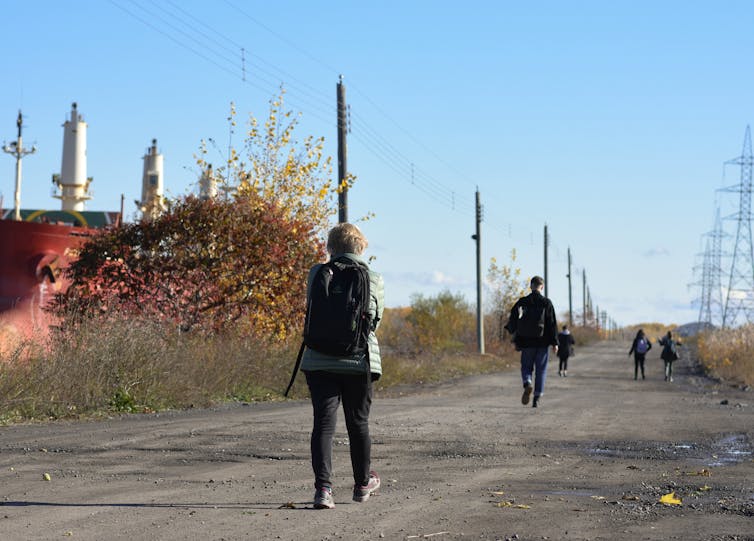
Indigenous activists have drawn attention to threatened waterways, neglected Residential School cemeteries and other social issues by walking across Land. Here a group of settlers on an Indigenous Land acknowledgment pilgrimage. Laurence Brisson/The Concordian, Author provided
Matthew Robert Anderson, Concordia University
University, religious, sports and other gatherings often begin with an Indigenous Land acknowledgement. For instance, this article was written in Montréal, or Tiohtiá:ke, on the traditional and unceded territory of the Kanien’kehá:ka (Mohawk), a place which has long served as a site of meeting and exchange amongst nations.
Land acknowledgements recognize what for some Canadians is an uncomfortable truth. These are formal statements that recognize “the unique and enduring relationship that exists between Indigenous Peoples and their traditional territories.”
On Land where territorial treaties were negotiated, the acknowledgement may use the term “traditional Lands,” and go on to specify the treaty and its number (Treaty 4, for example, includes much of southern Saskatchewan.) Land is so important that Gregory Younging — scholar, editor and author of the copyeditor’s book Indigenous Style — insisted Land be capitalized.
But when governmental and business meetings are far less likely to include acknowledgements of Indigenous Land titles, or when artistic and educational events move from initial statements to silence about their political and economic ramifications, it is hard to avoid the conclusion that such recognition is simply lip service.
What do groups mean when they say they recognize Indigenous presence, resilience and Land? And how can settler groups begin to walk the talk?
In 21 Things You Should Know About the Indian Act, author and president of Indigenous Corporate Training Bob Joseph urges Canadians to physically get out and get to know local First Nations. Ways to do this include attending Indigenous cultural or sports events or using Indigenous businesses.
As a settler academic who grew up on Treaty 4 territory, I have benefited from years of Indigenous guidance in ally-building in journey/pilgrimage studies, biblical studies and Land access. Following these learnings, I believe it is time for those of us who are not Indigenous to let our bodies learn about acknowledgement, sometimes by literally walking the talk.
Properly prepared “walking acknowledgements” are one way for those of us who are non-Indigenous to demonstrate that we mean what we say about unceded and traditional territories.

Location, location, location

It is by walking across Land that Indigenous activists have drawn attention and acknowledgement to waterways threatened by overuse or pollution, residential school cemeteries that have been neglected or abandoned, issues of justice for northern communities and, with displays of vamps (moccasin tops), Missing and Murdered Indigenous Women and Girls.
Margaret Kovach, Linda Tuhiwai Smith and other Indigenous academics consistently use the physical language of “grounding” and “place” to explain how one learns within Indigenous knowledge systems. They argue that Indigenous ways of knowing require the bodily recognition of one’s relationship to Creation and to others.
One of the first and most influential of Indigenous scholars addressing western research methods and Indigenous cultures, Māori professor of Indigenous education Tuhiwai Smith points out that it is always specific Land that gives meaning to Indigenous stories, ceremonies and history. Kovach adds that “self-location anchors knowledge within experiences.”

Understanding relationships to Land

This month, I led 11 students, faculty and friends on a 26-kilometre walk from Kahnawà:ke to the Department of Theological Studies at Concordia University, in Montréal, as a Territorial Acknowledgement for our Theology in the City conference. Walking helped us put our bodies where our mouths are. Those who have undertaken walking Land acknowledgements say it has both educated them and moved them away from political inaction and neutrality.
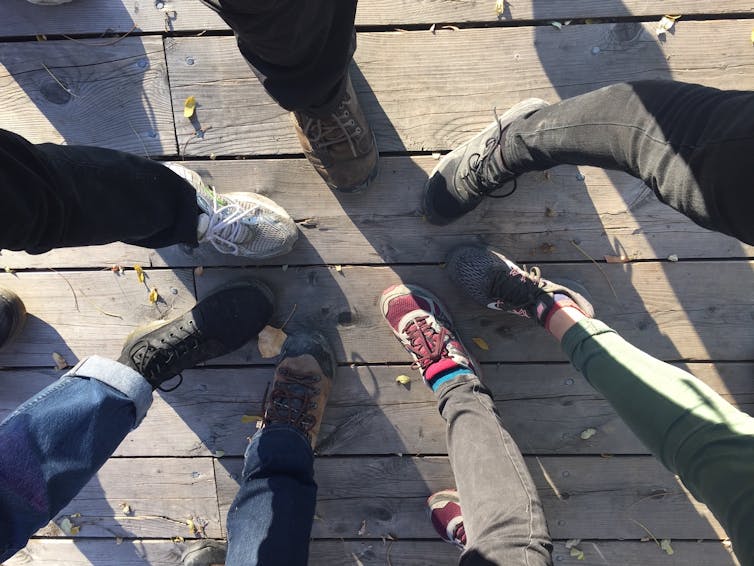
A pilgrim walk to help participants understand the true meaning of Indigenous Land acknowledgements took place last weekend in Montréal. Matthew Robert Anderson, Author provided

Showing up uninvited or unannounced is not acknowledgement. It risks being another colonial act. But with Indigenous guidance, we can physically get to know the Lands and people we are acknowledging.
These experiences help settler North Americans experience the locality and relationships that underlie most Indigenous understandings of Land. Getting to know the Land helps us learn its history — including its histories of colonization and of Indigenous resurgence.
Beginning in 2014, with the guidance and permission of the Mohawk Cultural Centre of Kahnawà:ke, and the Mohawk Nation at Kahnawà:ke Longhouse, professor of theology Sara Terreault and I have led groups of students from Concordia University on four annual pilgrimages.
We walked about 32 kilometres between Old Montréal, where the first French colonists built their churches and homes, and Kahnawà:ke Mohawk Territory. Some of our students had visited Kahnawà:ke before; some grew up in adjacent communities. Consistently, they reported in their project evaluations that walking the St. Lawrence Seaway, built in part on bulldozed Mohawk homes, and physically experiencing the contested border areas, and the First Nation, brought them new understandings of colonialism, economic injustice and histories of both oppression and resurgence.
Atsenhaién:ton Kenneth Deer, the secretary of the Mohawk Nation at Kahnawà:ke and a working group member of the United Nations Declaration on the Rights of Indigenous Peoples, assisted us on our walk and said:
“By walking from Concordia to Kahnawà:ke or from Kahnawà:ke to Montréal you can see how close we are but a world apart.”
U.S. anthropologist Chip Colwell notes that despite the risk of token gestures, repeating Land acknowledgements offers us a chance “to confront the past while laying the groundwork for building a shared future.”
Walking through such statements helps us remember that they are both real and political, and based on Indigenous assertions of title to real places.
Acknowledgements spur us to recognize not only Land, but also commitments made in the treaties, in the United Nations Declaration on the Rights of Indigenous Peoples, or in Canada’s Truth and Reconciliation Commission’s 94 Calls to Action.
Walking all, or some part of, our Land acknowledgements gets settlers out of their silos. It can help groups experience first-hand the Land, the relationships and the Indigenous Peoples of which the Land acknowledgements speak.
But walking Land acknowledgements are only first steps toward education and consciousness-raising. They are part of the process of non-Indigenous people becoming allies through Indigenous pedagogies. Only when Land acknowledgements are fully lived out — that is, when they deepen into meaningful economic, political and cultural change, will we really be walking in the true direction of reconciliation.
[ Deep knowledge, daily. Sign up for The Conversation’s newsletter. ]The Conversation
Matthew Robert Anderson, Affiliate Professor, Theological Studies, Loyola College for Diversity & Sustainability; Honorary Research Fellow, University of Nottingham UK, Concordia University
This article is republished from The Conversation under a Creative Commons license. Read the original article.

Sunday, 6 November 2016

Christmas storm in a coffee cup

As a Christian I feel the need to speak out and defend the right of coffee vendors not to put Diwali decorations on their take-out coffee cups, nor Eid decorations, nor Chanukah decorations nor Christmas decorations. They have the right to decorate or not decorate their coffee cups in any way they choose subject to the law of the land. If we do not uphold and defend this right then the alternative will be too ghastly to contemplate.

Denigrating them for not decorating their coffee cups with our particular flavour of religious celebration may be free speech, but it borders on harassment, badly models our own religion and is certainly one way of opposing the vendor's right. Tolerance is a prerequisite for the love that most religions claim as their hallmark. Let's at least get that much right as the festive seasons unfold.

(Photo credit: adweek.com)

Tuesday, 8 September 2015

How does Stephen Harper's response to the Syrian refugee crisis stack up?

In words that could apply equally to Canadian outgoing Prime Minister, Stephen Harper, newspaper columnist, Paddy Ashdown, has ridiculed British Prime Minister David Cameron’s offer for Britain to take 20,000 Syrian refugees over five years saying, "Nothing shows the prime minister’s tone deafness to the urgency of this situation better than this pathetic plan." In The Guardian of Monday, September 7th, Ashdown writes:

"Not only is this response calibrated more by political expediency than compassion, he has also indicated he believes the answer to the problem is more bombing. If the best part of two years of bombing with more than enough high explosive hasn't solved this problem, how would Britain’s widow’s mite of a few extra bombs help? Military strikes against Isis are failing, not because we do not have enough high explosive, but because we do not have a diplomatic strategy on Syria that would make sense of the military action."

I should point out that most of these refugees are not fleeing from ISIS but from the Assad regime! They were in refugee camps before ISIS hit the world news.

To date, the Harper Conservative government has accepted 2,300 Syrian refugees, and Stephen Harper, assuring us that the government is 'seized' with this issue,  has pledged to bring 10,000 more from the Middle East over the next four years if re-elected - just half the number promised by Cameron. The shortfall is in orders of magnitude even for the more 'generous' proposals of Mulcair and Trudeau. Compare against the 1.5 million in Turkey, or the 800,000 who will be accepted by Germany, or the 68,500 who settled in France last year.

Not In My Back Yard
Now here's a thought: The numbers we see fleeing the Syrian conflict will be tiny compared with the population movements we will soon be seeing as global warming compels more and more family crop farmers and cattle and goat herding farmers and nomads to leave their traditional lands and become migrant refugees. These people will not fit the current definition of refugees, let alone have paperwork to help them qualify for immigration anywhere; but Pope Francis is already saying that they are, indeed, environmental refugees.

What we are seeing now is just the tip of the iceberg. Clinging to miserly NIMBY-ism will carry a huge cost. Are there any white, 3rd or 4th generation Canadians who are not here because their forefathers (and mothers) immigrated here in search of a better life? Do we not justifiably hold them in grateful awe for the hardships they endured so that their descendants could have a better life?

Wednesday, 27 May 2015

Please, information about Jobs in Toronto for Quality Engineers

Somebody on one of the professional forums (fora?) that I subscribe to asked this question. Here is my slightly edited version of the question:
I am thinking seriously about moving to Canada in order to find a job as a quality engineer or quality manager or supervisor. I have broad experience in the automotive and railway industries for both positions.
A few days ago I read an article which said Toronto is a primary centre of industry and that the city and its surrounding area produces more than half of Canada's manufactured goods. On the other hand, someone told me that there were no jobs over there and that the unemployment rate is very high.
What is the real truth?. 
Are there real possibilities for me to find a job in that city and country?

My response is as follows:

I don't know what family ties and responsibilities you have but as an immigrant Canadian myself I would say, Don't come to Canada in order to find a job. 
Certainly, come to Canada because you like Canada, you like it's cosmopolitan make-up, you like its people, life-style, standard of living, geography, cold winters and hot summers, vacation opportunities, having the USA as your back yard, but don't come just in order to find a job. The immigration process is very arduous and you will not be allowed to work without a work permit (difficult to get) or landed immigrant status (even more difficult). 
Winter in Toronto
Come for a look-see. Do your Internet research on the immigration process. The Ontario unemployment rate is just under 7%. A LinkedIn job search will show that there are QA/QE jobs available in the greater Toronto area but there are typically a few dozen applicants for any one job so you will face competition. 
However, your basic question should be: do you really want to come to Canada or do you just want to find a job? There have to be easier ways to find a job.

Photo credit: CBC.ca

Saturday, 18 April 2015

Xenophobia in South Africa. Does 'Mississippi Burning' Help Us Understand?

Earlier this week Daily Maverick published an op-ed by Stephen Grootes covering the horrific xenophobic violence currently hitting South Africa under the title, When the economy suffers, xenophobia thrives. I agree with everything Stephen Grootes has written there, most especially what he says about impunity, poverty and feelings of hopelessness in bad economic times. I strongly recommend that you link to and read that op-ed before reading this blog any further.

Insightful and enlightening as the piece is, I can't help getting the feeling that Grootes is holding back, perhaps understandably. It's as if he has set the stage for an explanation; all the props and actors are there and even some historical context, but the dialogue is missing.

Perhaps the missing dialogue can be found in the following dialogue from the movie Mississippi Burning.

Ward: Where does it come from, all this hatred?

Anderson: You know, when I was a little boy, there was an old Negro farmer lived down the road from us, name of Monroe. And he was, uh, - well, I guess he was just a little luckier than my Daddy was. He bought himself a mule. That was a big deal around that town. Now, my Daddy hated that mule, 'cause his friends were always kiddin' him about oh, they saw Monroe out plowin' with his new mule, and Monroe was gonna rent another field now they had a mule. And one morning that mule just showed up dead. They poisoned the water. And after that there was never any mention about that mule around my Daddy. It just never came up. So one time, we were drivin' down the road and we passed Monroe's place and we saw it was empty. He'd just packed up and left, I guess. Gone up North, or somethin'. I looked over at my Daddy's face - and I knew he'd done it. And he saw that I knew. He was ashamed. I guess he was ashamed. He looked at me and he said: 'If you ain't better than a n****r, son, who are you better than?'...He was an old man just so full of hate that he didn't know that bein' poor was what was killin' him.

Friday, 21 December 2012

What stops a bad guy with a gun?

“The only thing that stops a bad guy with a gun is a good guy with a gun” NRA Executive Vice President Wayne LaPierre.

Oh dear. What has happened to logic? Why is the above statement from LaPierre true and the following statement false: The only thing that stops a good guy with a gun is a bad guy with a gun?

The fact is, neither of the statements are true in and of themselves. Whether the guy with a gun is good or bad is no predictor of the outcome of a gun duel. I am no gun expert but I would expect that, all things being equal with fire-power, aim, expertise, etc., the guy who gets in the first shot will stop the other guy most of the time, regardless of who is good and who is bad. Of course, all things being equal seldom applies, anyway.

About twenty years ago or more my wife and I were discussing a South African statistic that went along the lines that the most likely victims of gun violence were the owner of the gun or close family members of the gun owner, and that gun owners or their families were more likely to be killed or receive gunshot wounds than the general population. That confirmed our decision never to own a gun or to have one in our home. My impression from stories of gun violence here in Canada and elsewhere is that this still seems to hold true.

I like what Republican Senator Tom Coburn (R-Okla.) said in response to the suggestion from LaPierre that armed guards should be put in schools. “It’s fixing the wrong problem, because the problem is cultural,” he told reporters on Capitol Hill.

Even that is decidedly simplistic but it is heading in the right direction. Mental health has to be another huge factor in the equation. I don't know what the answer is but anybody who fastens on just one, simplistic solution is surely being simple-minded.

Sunday, 22 July 2012

Toronto Mayor's Solution to Guns and Gangs - Lower Taxes


You can't make up this stuff. An important plank in Mayor Rob Ford's solution to the city's gun violence is to lower taxes for businesses so companies can create jobs so that gang members can "get a job."

I naively thought that Ford could not surpise me any more. I was wrong. Click the link and read on.


Tuesday, 13 September 2011

Questions to ask Ontario's aspiring next premiers before going to the polls.

Tax credits for new immigrants
This whole brouhaha about the tax credit for businesses employing new foreign Ontarians (or Ontarian foreigners) is actually very unfortunate other than for the obvious reason of being xenophobic and culturally divisive. It serves Hudak right that he has gone down in the polls since he jumped on this in the hope that it would serve his purposes as a wedge issue.

However, it has served the purposes of both Hudak and McGuinty in that they can focus public attention on something relatively insignificant in the grand scheme of things and not have to explain how they will deal with the big issues of the day; somewhat like a conjurer using sleight of hand to distract you while he does his trick. From what I have been reading and reflecting upon, there are three cluster issues that politicians of the day need to address at provincial and federal levels: jobs and the economy; healthcare ; power generation and the environment. Overarching all three is the issue of taxes.

Jobs and the economy
There is a mantra that I keep hearing that lowering taxes will stimulate the economy; raising taxes will kill the economy. The assumption seems to be that if you lower taxes then people will spend that money locally in a way that will benefit local business. How much money are we talking about here? Let's say $360.00 per year for a middle class family. If that $30 per month does not result in new jobs being created locally, or in Ontarian businesses being able to use that $30 to generate another $10 or $20 or $30, then all that $30 amounts to is a politician buying votes by cutting services. An extra thirty dollars a month does not automatically spell an improvement in living standards if a single mom has greater difficulty finding a daycare spot or the family of someone who is mentally ill can no longer find the care their daughter/sister/mother needs. 

McGuinty, Hudak and Company, what exactly is your strategy for job creation and please don't tell me tax cuts or ending the gravy train.

Healthcare
The median and the average ages of the population are getting older. At the same time as a large number of Ontarians start leaving the workforce, more and more of those retirees are going to need more and more acute and long-term healthcare. Put in another way, more public healthcare is going to be needed with proportionately fewer people to pay for it. Right now, Healthcare is paid for almost entirely by taxes. Our politicians are all pledging enormous amounts of money for the future of Healthcare. Some of those same politicians are pledging to reduce taxes. Hmmm. It doesn't take a rocket scientist to work out that something's got to give, somewhere. The American model is that anything can be fixed if you throw enough money at it. Oops. We've just hit the wall on that one. No more money. Healthcare may need more money, but it also needs a new solution in terms of structuring, priorities and who can give what care and where and to whom. The present model is simply not sustainable in the medium term, let alone the long term. Not to mention the fact that many chronic illnesses have their origins in our CO2 polluted environment or exposure to other toxins in the air we breathe or the water we drink - all of which is getting worse.

McGuinty, Hudak and Company, what exactly is your strategy for ensuring the medium and long term healthcare needs for Ontarians, and please don't tell me you are going to throw money at the problem? We all know that there IS no money because you are not going to raise taxes or cut services.

Power generation and the environment
In 2007, CTV News quoted Stephen Harper as saying that Canada "must act" to curb global warming, and John Baird as saying, "We've clearly got to take action. I think Canadians don't want to hear what can't be done but they want to hear what action will be taken by their government and we hear that call."

Yes. Well, that was 2007 and Canadians are still waiting to hear. Meanwhile global warming and other environmental issues are getting worse at an increasing rate and the world's accusation is that Canada is one of the worst offenders. At the same time we need to decide now and start implementing now our green power generation programs so that we are positioned to supply the energy needs that the future expanding economy, with all the new jobs, is going to need when it all starts happening. A lesson from South Africa is that you cannot wait until you need it to start building your new power generators.

McGuinty, Hudak and Company, what exactly is your strategy for new power generation, and please don't tell me energy from coal, oil, gas or nuclear fission?

Taxes
I want good, affordable healthcare, the more so as I grow older. I want good roads to drive on and reliable public transit when I need it; I want good schools for my grandchildren. I want my garbage collected. I want clean drinking water and I want health inspectors to ensure that I can go to a restaurant and enjoy a meal without spending the rest of the night suffering the bi-directional after effects of bad hygiene in the chef's kitchen. The list could go on and on. If I go to hospital I want to know that certain standards of cleanliness and hygiene are the norm and that I will be treated by properly qualified medical staff. To ensure all this and so much more I am more than happy to pay taxes. I would complain if I felt I was not getting a good bang for my tax dollar but, honestly, I cannot say that. On the contrary, I would be quite happy to pay more if I knew it would help address the issues above. I long for the day when some honest politician stands up and says, "Here's my platform. You've got to pay more taxes. Here's why this is a good thing that you should jump at: etc., etc." If nothing else, people would know they're being honest.

Monday, 25 July 2011

Vacation Update #1

Ingrid and I are on our Way to Winnipeg for Jonathan's baptism planned for this coming Sunday - in Saskatchewan, actually, where Luisa's sister and her husband and family live on their farm.

We set out on Saturday morning for Tobermory where we had booked a ferry to take us to Manitoulin Island. The ferry trip was notable for the beauty of the island views on the water, the numerous pictures of sea gulls that I took as they slowly overtook the ferry, the thick fog that settled in unexpectedly - at least for me.

On "The Island" we stayed at Willow Shores, a B&B run by Gord and Charleen Gorman. I can tell you straight off that Ingrid and I were both very happy with our stay there; we would definitely use it again if the occasion arose and I certainly recommend it to any friends travelling that route. Manitoulin Island, by the way, is the largest island in a freshwater lake in the world.

Saturday night we had an unscheduled and unexpected treat. After fish and chips at a pub called The Musky Widow we were invited to attend a poetry competition put on across the road by a local Aboriginal theatre group, Debajehmujig.

Immaculate Conception Church, Manitoulin Island
We spent Sunday sight seeing and eating, starting off with the high point, mass at the Church of the Immaculate Conception, built to resemble a roundhouse and incorporating elements of First Nations culture into the liturgy and church architecture and furnishings.

Today, Monday, we had an uneventful but enjoyable drive to Sault St Marie. Ingrid and I have just enjoyed a jacuzzi in our new B&B. Up early tomorrow for a planned day outing on the Agawa Canyon Tour Train.

Good night.

Sunday, 15 August 2010

Friendship Appreciation Day

Today I want to express my appreciation to all of you my friends. Thank you for being my friend and letting me be your friend. This includes members of my family, blood and in-law, and starts especially with my wife, Ingrid, my best friend.

You, my friends, make up a widely and wildly disparate group of people. Some of the variations are common to most people's friends : I have friends who are old, friends who are young, male and female, friends of different nationalities, racial backgrounds and different economic and educational backgrounds. Many of my friends are apolitical while others are decidedly left or right wing or fringe. I even have a very few friends who, like me, are Green supporters. I have American friends who support the Republicans and some who are Democrats. Some of my Canadian friends seem to know more about American political issues than Canadian. Some Canadian friends are wannabe Americans and some define their identity as decidedly not-American.

To my knowledge none of my friends are neo-Nazis and if you are a closet neo-Nazi then I don't want to be your friend any more.

I have been out of South Africa so long I no longer know who supports which parties but I think the ANC and the DA account for most of you.

Some of my friends are Québécois who think that the best thing for Quebec is to leave the Canadian federation. I have some English speaking Canadian friends who think that the best thing for Canada is for Quebec to leave the Canadian federation.

Some friends are deeply religious, whether Jewish, Christian, Hindu or Moslem. Some are decidedly atheist. Some don't know and don't care if there is a God or gods and aren't sure what the difference is between atheism and agnosticism. They don't mind if I pray for them. Thank you.

I have friends who are straight as a laser beam and other friends who are, or whose children are, gay, lesbian or queer.

I have friends who are passionately Pro-Life and others who are just as passionately Pro-Choice. For the record, I am passionately Pro-Life but I seriously doubt the usefulness of hurling insults at people who believe differently to me.

I am under the impression that very few of you have a similar mix of ingredients to me. It is highly probable that most of my friends would not like most of my other friends. I should be used to that by now. My mother would not have liked many of my friends and I was careful not to bring them home.

But I like you all and I value your friendship. Heck, some of you even asked me to be your friend on FaceBook! I value that, especially considering one of my own family clicked ignore to my friend request !:-) I can live with that. We are good friends in other ways.

Once again, thank you for being my friend and thank you for letting me be your friend.

This is my daughter Miriam (right) and her friend Liora.
Childhood friends and still friends today.

Wednesday, 14 April 2010

Another Victim's Response

I received the following response to my last blog in an email from a lady who has given me permission to publish but wishes to remain anonymous.

Hi, VERY TOUCHING!!! I read it with many mixed emotions surfacing. I too have been personally affected by abuse. Not by clergy, but by relatives and a doctor. For a long time I was angry at the people who I confided in who failed me...people I loved and trusted...(my mother and my husband) so I understand why abuse victims, who have already been violated beyond words feel betrayed by those who could have stopped it!! But, in their defense I have to add culture was different then. You just did not talk about such things! It seems (if we did not acknowlege that it was true, we did not have to deal with it and maybe it would just go away...plus the victim was often viewed as the guilty party.This was not uncommon in rape cases where lawyers attacked the character and good name of the victim in order to let the abused get off) I think some of those who could have made a difference felt that they were doing all that they could, because they confronted the abuser, and more or less disciplined him/her, by transfering them or by taking away certain freedoms....I believe ignorance is the WORST enemy of TRUTH!
Like you, in the context of prayer groups and sharing sessions I have met a very large number of women (and some men) who, like me, were abused by older brothers or other relatives. Does that mean that all boys can't be trusted??? I hope not!
All that having been said, when I hear the media reports they enrage me!!! I want them to tell the truth and they are NOT!! There is a blatent 'Anti-Catholic' sentiment among journalists...to the point that some in the Jewish community have jumped to the Holy Father's defence...which only fuelled the anti-Catholic agenda of the media.
Here are some noteworthy facts to help keep things in perspective:
-- physical and sexual abuse, especially of children, is a mortal sin and a dispicable act, it always was and always will be and justice should be done, if it is not done in this world we can be sure it will be in the next.
-- to that end, no one has done more than Pope Benedict to eradicate this foul stench from the Church and the clergy...yet the media continue to attack his credibility reporting situations falsely and twisting the facts to sell news
-- of all those guilty of sexual abuse of children, 2% are Catholic Clergy.
-- almost all cases of sexual abuse by Catholic Clergy happened more than 30 years ago...yet, many innocent and holy Catholic Clergy are viewed as suspect to this day.
-- Jesus promised, when he founded The Catholic Church naming St. Peter the first Pope, that the gates of Hell will not prevail against Her (the Church). In the eye of the storm I cling to this Truth!
Human nature wants to lash out, to punish those who hurt us...to get even. But, that is not what Jesus wants...only by His grace can we forgive those who have sinned against us which is what He wants to help us do, and then leave justice up to Him.

Friday, 26 June 2009

Multiculturalism Day at the Office

-

Today we had Multiculturalism Day at GE. I was very impressed by the extent to which a number of people really got into the spirit of it all and have set up mini displays around their office workspace over the last two weeks. Here is a sampling. For the full set of photos have a look at my album, 2009 GE Multiculturalism Day.