As must be the case with many of you reading this, my father and grandfathers fought in the two world wars of the twentieth century. They, and our family, were fortunate that they survived, although my wife has an uncle in her ancestry who lost his life when his ship sank in a naval engagement, and my dad came out of the war minus one lung. Canada, South Africa, Australia, New Zealand were not under direct attack or threat in the same way as were the countries of Europe and Britain. Their armies were fighting not so much for their own motherland as helping defend and liberate their allies and for the values and principles of world liberty and freedom from tyranny.
I find it disappointing, therefore, when I read so often in the social media that people are advancing an anti-refugee position by bemoaning how "our government" can find money to assist refugees but cannot properly assist "our vets". Please, let's keep the two issues separate. By all means, let us lobby for a better deal for our war veterans, but not on the backs of the most vulnerable. This is disingenuous and an insult to the very ones who died in the wars, who died for something far nobler than keeping "our country" free from refugees.
So, here is my
question: Are there or are
there not provincial or federal laws or regulations prohibiting the release
ofcommercial and industrial waste and,
especially, raw sewage into the rivers of Canada or, at least, the rivers and
aquifers of Ontario?
If not, why not? If
yes, how are they enforced?
I ask after being
shocked to read the following article in Global News:
Oneida Nation of the Thames tap water different than
neighbouring non-Indigenous communities
Particularly
disturbing are the following three paragraphs:
"18 years of
water quality testing across Oneida First Nation sometimes shows striking
levels of dangerous pathogens such as E. coli flowing from residential taps. Upstream, the nearby city of London dumps millions of
litres of raw sewage into the Thames River that serves as the
community’s water source…"
"The Thames
River, which replenishes Oneida’s aquifer, is a dumping ground for waste, raw
sewage and pollution. To avoid basement flooding during heavy rains, London’s wastewater system dumps rainwater and raw
sewage into the river. In 2018, 266 million litres of raw sewage was
released and flowed downstream through several First Nations communities,
including Oneida.
"So far this year, more than 5.7 million litres of
London’s raw, untreated sewage — including commercial and industrial waste —
has been dumped into the river, according to city data.
London didn’t start
notifying Oneida of sewage dumps until mid-2018, say Oneida leaders, including
Chief Hill. Even then, Oneida is only notified after the dump has occurred,
sometimes hours or days later."
Here, again, is my
question: Are there or are
there not provincial or federal laws or regulations prohibiting the release
ofcommercial and industrial waste and,
especially, raw sewage into the rivers of Canada or, at least, the rivers and
aquifers of Ontario?
If not, why not? If yes, how are they enforced?
I realise that the
question is rhetorical. Doing just 2 minutes of searching on the Internet I
found that:
raw
sewage overflowed into southern Ontario waterways 1,327 times in the 12 months
ending March, 2018;
the
city of Toronto releases more than 1-billion litres of
raw sewage into Lake Ontario in a single day;
when
excessive stormwater has nowhere to escape, it funnels into sewers causing them
to overflow and spill untreated contents into lakes or rivers;
there are
provincial regulations but they are full of loopholes circumventing
enforcement.
I have
been following a Facebook group focusing on drinking water and other water
availability issues in South Africa. They regularly bemoan the fact that, due
to aging infrastructure, neglect and poor accountability, raw sewage is spilling into some of the dams sourced
for drinking water. I have been feeling lucky to be living in Canada - a First World
country after all. How presumptuous and arrogant of me.
A friend who knows I'm a climate change nut challenged me, asking my thoughts on a rather scathing newspaper op-ed. My response follows.
We have a climate crisis of global warming that requires urgent attention. I say this with confidence because it is not merely my opinion, or anyone else's opinion, but a fact established with evidence from science and attested to by climate scientists worldwide. This according to NASA, the National Aeronautics and Space Administration of the USA. (See https://climate.nasa.gov/evidence/)
Along with the global warming issue we have serious problems with air pollution that are having devastating effects upon vulnerable people whose lungs and breathing ability are already compromised, as well as people with cardio-vascular illnesses. We can only guess how much impact this is also having on childhood development, or life expectancy in the elderly. See, for instance: https://www.canada.ca/en/health-canada/services/air-quality/health-effects-indoor-air-pollution.html
Thirdly, there is the contribution that environmental issues make to the "refugee crisis" that we hear so much about and feel the need to 'control' without thinking about controlling the causes of environmental degradation which is very much a root cause of migration for environmental refugees. According to Pope Francis: “Climate change is also contributing to the heart-rending refugee crisis. The world’s poor, though least responsible for climate change, are most vulnerable and already suffering its impact.” https://www.independent.co.uk/news/people/pope-francis-climate-change-environment-refugee-crisis-destroy-sin-a7221476.html
What to do?
First of all, what NOT to do! I honestly do not think it is at all helpful when people look at their neighbours in countries that are oceans and continents away, or just a province or two away, or "on the reserve", and point out that, since THEY are contributing so significantly to the problem, what is the point of politicians trying to force ME to make sacrifices - as with a carbon 'tax'? As I see it, that line of reasoning lets us all off the hook of sacrifice. Not only can we just leave the problem, then, for our grandchildren to solve but we can feel free to continue exacerbating the problem by pushing out limitless pollutants seeing as our contribution is so small - relatively speaking.
The other thing NOT to do is give greater credibility to politicians and economists and their populist journalist followers (left, right and centre) than the credibility we afford climate scientists. It is inexcusable that government bureaucrats implement environmental policy changes without consulting scientists. More inexcusable is when governments then gag their own publicly funded scientists and not allow them to publish their peer-reviewed research.
I use gasoline to drive my car. I would love to be driven in a clean-energy taxi. I use liquid natural gas to warm my house. (As I write, the temperature today has warmed up to a high of +2C - the highest it has been in the last 5 days.) I would love to warm my house with power from the sun or wind, but our local government cancelled, at great expense in penalties, the renewable energy program initiated by the previous local government. My point is that there are some initiatives that cannot be undertaken by individuals without incurring prohibitive personal expense. Such initiatives require changes to infrastructure that can only be achieved by local and national governments. But the will has to be there. As I see it, partisan political loyalties, fueled by the things NOT to do that I describe above, are the major obstacles to people even seeing the need, let alone developing the socio-political will.
Let's get off the darkness band-wagon and switch on an LED candle, and try to influence the people around us to do the same. "Lord, make me an instrument of your peace... "
Learning the Land: Walking the talk of Indigenous Land acknowledgements
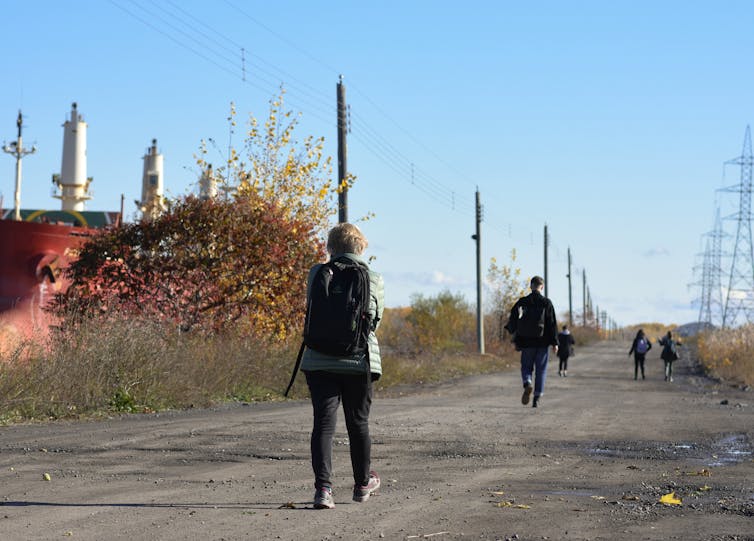
Indigenous activists have drawn attention to threatened waterways, neglected Residential School cemeteries and other social issues by walking across Land. Here a group of settlers on an Indigenous Land acknowledgment pilgrimage.
Laurence Brisson/The Concordian, Author providedMatthew Robert Anderson, Concordia University
University, religious, sports and other gatherings often begin with an Indigenous Land acknowledgement. For instance, this article was written in Montréal, or Tiohtiá:ke, on the traditional and unceded territory of the Kanien’kehá:ka (Mohawk), a place which has long served as a site of meeting and exchange amongst nations.
Land acknowledgements recognize what for some Canadians is an uncomfortable truth. These are formal statements that recognize “the unique and enduring relationship that exists between Indigenous Peoples and their traditional territories.”
On Land where territorial treaties were negotiated, the acknowledgement may use the term “traditional Lands,” and go on to specify the treaty and its number (Treaty 4, for example, includes much of southern Saskatchewan.) Land is so important that Gregory Younging — scholar, editor and author of the copyeditor’s book Indigenous Style — insisted Land be capitalized.
But when governmental and business meetings are far less likely to include acknowledgements of Indigenous Land titles, or when artistic and educational events move from initial statements to silence about their political and economic ramifications, it is hard to avoid the conclusion that such recognition is simply lip service.
What do groups mean when they say they recognize Indigenous presence, resilience and Land? And how can settler groups begin to walk the talk?
In 21 Things You Should Know About the Indian Act, author and president of Indigenous Corporate Training Bob Joseph urges Canadians to physically get out and get to know local First Nations. Ways to do this include attending Indigenous cultural or sports events or using Indigenous businesses.
As a settler academic who grew up on Treaty 4 territory, I have benefited from years of Indigenous guidance in ally-building in journey/pilgrimage studies, biblical studies and Land access. Following these learnings, I believe it is time for those of us who are not Indigenous to let our bodies learn about acknowledgement, sometimes by literally walking the talk. Properly prepared “walking acknowledgements” are one way for those of us who are non-Indigenous to demonstrate that we mean what we say about unceded and traditional territories.
This month, I led 11 students, faculty and friends on a 26-kilometre walk from Kahnawà:ke to the Department of Theological Studies at Concordia University, in Montréal, as a Territorial Acknowledgement for our Theology in the City conference. Walking helped us put our bodies where our mouths are. Those who have undertaken walking Land acknowledgements say it has both educated them and moved them away from political inaction and neutrality.
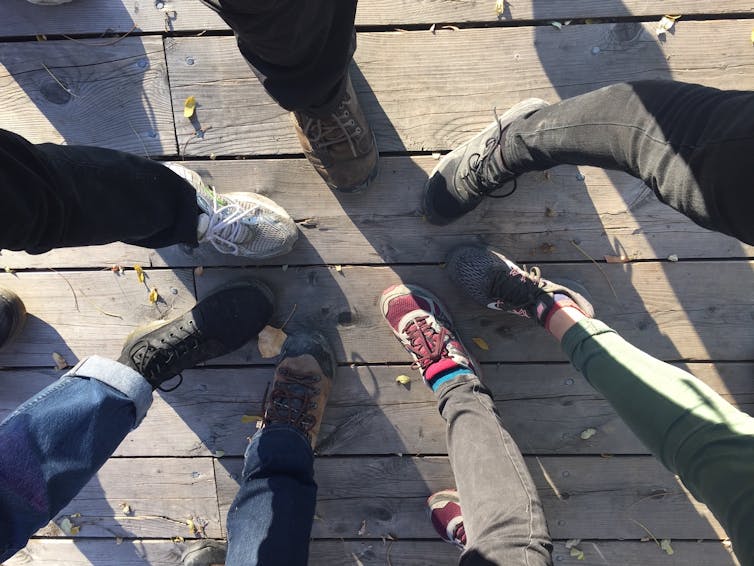
A pilgrim walk to help participants understand the true meaning of Indigenous Land acknowledgements took place last weekend in Montréal.Matthew Robert Anderson, Author provided
Showing up uninvited or unannounced is not acknowledgement. It risks being another colonial act. But with Indigenous guidance, we can physically get to know the Lands and people we are acknowledging.
These experiences help settler North Americans experience the locality and relationships that underlie most Indigenous understandings of Land. Getting to know the Land helps us learn its history — including its histories of colonization and of Indigenous resurgence. Beginning in 2014, with the guidance and permission of the Mohawk Cultural Centre of Kahnawà:ke, and the Mohawk Nation at Kahnawà:ke Longhouse, professor of theology Sara Terreault and I have led groups of students from Concordia University on four annual pilgrimages. We walked about 32 kilometres between Old Montréal, where the first French colonists built their churches and homes, and Kahnawà:ke Mohawk Territory. Some of our students had visited Kahnawà:ke before; some grew up in adjacent communities. Consistently, they reported in their project evaluations that walking the St. Lawrence Seaway, built in part on bulldozed Mohawk homes, and physically experiencing the contested border areas, and the First Nation, brought them new understandings of colonialism, economic injustice and histories of both oppression and resurgence. Atsenhaién:ton Kenneth Deer, the secretary of the Mohawk Nation at Kahnawà:ke and a working group member of the United Nations Declaration on the Rights of Indigenous Peoples, assisted us on our walk and said:
“By walking from Concordia to Kahnawà:ke or from Kahnawà:ke to Montréal you can see how close we are but a world apart.”
U.S. anthropologist Chip Colwell notes that despite the risk of token gestures, repeating Land acknowledgements offers us a chance “to confront the past while laying the groundwork for building a shared future.”
Walking through such statements helps us remember that they are both real and political, and based on Indigenous assertions of title to real places.
Acknowledgements spur us to recognize not only Land, but also commitments made in the treaties, in the United Nations Declaration on the Rights of Indigenous Peoples, or in Canada’s Truth and Reconciliation Commission’s 94 Calls to Action.
Walking all, or some part of, our Land acknowledgements gets settlers out of their silos. It can help groups experience first-hand the Land, the relationships and the Indigenous Peoples of which the Land acknowledgements speak.
But walking Land acknowledgements are only first steps toward education and consciousness-raising. They are part of the process of non-Indigenous people becoming allies through Indigenous pedagogies. Only when Land acknowledgements are fully lived out — that is, when they deepen into meaningful economic, political and cultural change, will we really be walking in the true direction of reconciliation.
[ Deep knowledge, daily.Sign up for The Conversation’s newsletter. ] Matthew Robert Anderson, Affiliate Professor, Theological Studies, Loyola College for Diversity & Sustainability; Honorary Research Fellow, University of Nottingham UK, Concordia University
This article is republished from The Conversation under a Creative Commons license. Read the original article.
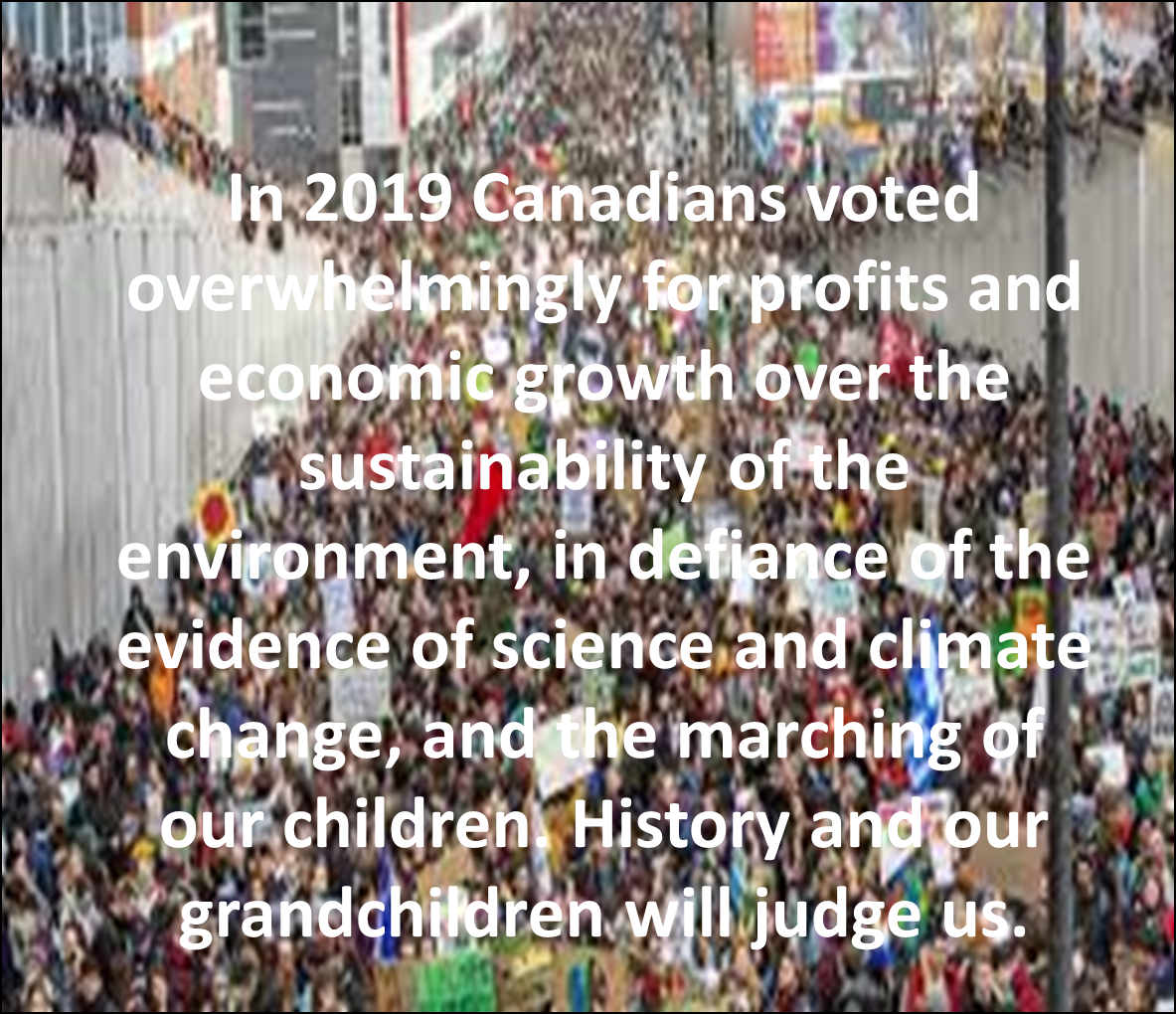
In 2019 Canadians voted overwhelmingly for profits and economic growth over the sustainability of the environment, in defiance of the evidence of science and climate change, and the marching of our children. History and our grandchildren will judge us.
The Paris Agreement's long-term temperature goal is to keep the increase in global average temperature to well below 2 °C above pre-industrial levels; and to pursue efforts to limit the increase to 1.5 °C. This requires countries to cut emissions by 45% by 2030, end fossil fuel subsidies and ban new coal plants after 2020. Most of our parties talk about "reducing" carbon emissions but do not set goals to cut emissions by 45% by 2030.
The Conservative Party climate plan has been almost universally panned by experts for failing to have any reasonable chance of achieving the weak 2030 emissions targets the Harper government set. It is as good as no plan, which is a plan to fail.
Although better than the Cons, the Liberal climate plan is to reduce our emissions by 30% by 2030, compared to 2005 levels. This falls way short and is a plan to fail.
The NDP talk about achieving targets in line with scientific consensus. This definitely sounds better than the Liberals but they support new fossil fuel projects which will make achieving the goal impossible.
The Green Party has the most aggressive plan which clearly heeds the UN’s call for rapid and transformative changes to Canadian society. The plan has faced criticisms for being unrealistic in scope and speed, but there is broad consensus that it would exceed emissions targets if implemented.
If you still don't understand, ask 16 year old Greta Thurman to explain. She gets it.
Jesus told the pharisees: “You know the saying, ‘Red sky at night means fair weather tomorrow, red sky in the morning means bad weather today.’ You are good at reading the signs of the weather in the sky, but you can’t read the obvious signs of the times!” (Matthew 16:2-3)
Bl. Frederick Ozanam beautifully illustrated what it means to read the signs of the times in this following extract from a letter that he wrote to a friend in 1838. Listen to these words bearing in mind that the 2nd French Revolution occurred in 1830 and the 3rd revolt happened in 1848, the same year that the Communist Manifesto was published.
Barricades at Rue Soufflot on 24 June 1848 - Vernet
The question which divides people in our day is no longer a question of political forms, it is a social question—that of deciding whether the spirit of egotism or the spirit of sacrifice is to carry the day; whether society is to be a huge traffic for the benefit of the strongest, or the consecration of each for the benefit of all, and above all for the protection of the weak. There are many who already have too much, and who wish to possess still more; there are a greater number who have not enough, and who want to seize it if it is not given to them. Between these two classes of people a struggle is imminent, and it threatens to be terrible—on one side the power of gold, on the other the power of despair. It is between these two opposing armies that we must precipitate ourselves.
Talking to us about this quotation at our recent "Recharge the Batteries" event, Fr Roy commented that this letter was prophetic. Indeed it was, coming ten years before the "third" revolution and the publication of the Communist Manifesto.
Blessed Ozanam saw Christ in the poor and the weak, but he did not see them through rose-tinted eye glasses. He saw very clearly that the same spirit of egotism that was evident in the rich and powerful aristocracy as well as the middle class bourgeoisie, was also powerfully at work in the desperation of the impoverished working classes. As he saw it, the only thing that could possibly make a difference would be if Catholics and other Christians of France in his time could set aside their own spirit of egotism and replace it with a spirit of sacrifice in faithfulness to the teachings and call of Jesus Christ, "Come, follow me."
We are at a time when overwhelming and increasing numbers of environmental scientists are telling us that our planet is fast approaching a tipping point. In his encyclical, Laudato Si', Pope Francis tells us, "There has been a tragic rise in the number of migrants seeking to flee from the growing poverty caused by environmental degradation. They are not recognized by international conventions as refugees; they bear the loss of the lives they have left behind, without enjoying any legal protection whatsoever. Sadly, there is widespread indifference to such suffering, which is even now taking place throughout our world. Our lack of response to these tragedies involving our brothers and sisters points to the loss of that sense of responsibility for our fellow men and women upon which all civil society is founded." (LS #25)
Blessed Ozanam's words are no less prophetic and applicable to our times today where political parties in campaigns for the coming election are appealing to our spirit of egotism to persuade us to vote for them - some more so than others, and most offering no more than lip service to the environmental crisis as merely one issue among many others. Between the opposing powers of gold and despair, Ozanam says we have to 'precipitate' ourselves. I do not know the original French word and do not even speak French, but this use of 'precipitate' in the English translation suggests urgently throwing oneself headlong into a situation without taking sufficient time to consider the consequences, much like a parent might rush into a burning house to rescue a child.
As Vincentians, which spirit do we want to drive us? The spirit of egotism or that of sacrifice? I must confess that I feel nervous and ambivalent about 'precipitating' myself into the gap between the rich and powerful on the one hand, and the poor and desperate on the other. Perhaps that is the difference between saints and the rest of us, but let us take inspiration from our founder and model, nevertheless. The very existence of our Society of St. Vincent de Paul is a direct consequence of precipitous action that Frederick Ozanam took in 1833. The same question posed by Blessed Ozanam in 1838 faces us as Christians and Vincentians going into voting booths in 2019: that of deciding whether the spirit of egotism or the spirit of sacrifice is to carry the day, for the benefit of the strongest, or for the benefit of all, and above all for the protection of the weak?
"Until you start focusing on what needs to be done rather than what is politically possible, there is no hope. We cannot solve a crisis without treating it as a crisis." - Greta Thunberg
At election time, which issues should we focus on when marking an 'X' on our ballot? Eons ago Bill Clinton's presidential campaign famously said, "It's about the economy, Stupid." In 2016 Carl Anderson, Supreme Knight of the Catholic Knights of Columbus, said that abortion is not “just another political issue" but "is in reality a legal regime that has resulted in more than 40 million deaths. What political issue could possibly outweigh this human devastation?" As a result a large number of Roman Catholics voted for Donald Trump who had declared himself against abortion. Again, there are many people today who have voiced the opinion that immigration and migrants make up the issue of the day.
Daniel P. Horan, a Franciscan friar and assistant professor of systematic theology and spirituality at Catholic Theological Union in Chicago writes:
What good is it to prevent abortions or save the elderly from euthanasia or ensure the elimination of capital punishment if there is no air to breathe, water to drink, land to farm, plants or animals to eat, or habitats free from flooding, hurricanes, wildfires, tornados, earthquakes or some of the other devastating weather phenomena? I'm not suggesting that we ignore those discrete life issues; they demand prayer and action, too. However, there is a uniquely dire valence to what is happening to our planet and a very limited window to do anything to save the very possibility of life on this planet at all.
As a Christian, I am ashamed to say that Christians, in their Pro-Life support for Donald Trump, are complicit in the Anti-Life deaths of thousands of civilians killed in coalition airstrikes since the conflict in Yemen began in 2014, not to mention MILLIONS suffering from shortages of food and medical care in a country (the poorest in the world) pushed by war to the brink of famine. The U.S. and Canada are both making many millions of dollars from sale of arms to Saudi Arabia. A shame on us if we remain silent in the face of this preventable human suffering made worse by our greedy trade. Canada is not innocent either.
Pro-life advocates with the Indiana State Knights of Columbus carry a banner past the U.S. Supreme Court Jan. 27 during the annual March for Life in Washington. (CNS/Leslie E. Kossoff)
I am greatly concerned that the President of the United States publicly tells untruths on what appears to be an habitual basis.
It concerns me even more that millions of the American public either believe these falsehoods unquestioningly or don't seem to care that he may be lying and continue to support him in Congress and the Senate and in the media.
My greatest and deepest concern, however, is that Trump himself appears to believe many, if not all, of these untrue assertions, many of which are oft repeated by him. If that is indeed the case, then the President of the United States is delusional, even if sincerely so. Can it really be that a delusional man has access to "the codes" that could trigger nuclear war?
I remember when I was a boy that the Catholic mother of my friend phoned my non-Catholic mother to ask her if she would help her abort her baby. (Illegal in South Africa with stiff penalties.) My mother, who did not realise I could overhear her side of the conversation, said she certainly would not but she did know somebody who did that stuff.
My friend never did get that or any other baby brother or sister. I know that their family struggled financially compared to us, and I know how our family struggled and had to do without things that lots of other people seemed to have.
Life is complex and people suffer terrible stress that clouds judgement and removes freedom.
Much as I want to defend unborn children and their God-given right to life, I don't think it is for me to judge others by my religious and moral standards or to impose my religious and moral standards by turning them into legislation.
I am very conflicted by all of this. Those who disagree with me, please try not to judge me too harshly.
This letter from some Catholic groups in the United States of America exemplifies the difference that I see between the pro-life movement and Pro-Life, which seems to me to place extraordinary if not exclusive emphasis on being "Pro-Birth". If you are truly pro-life then your concern has to extend beyond protecting the unborn and, in protecting the unborn, to do so in the most compassionate and effective way possible in the long term, not merely the most vociferous and judgemental - which is a common perception of Pro-Life. Interestingly, another difference between pro-lifers and Pro-Lifers seems to manifest in a difference of support for Donald Trump as president.
"Catholics need
to stop voting for pro-abortion politicians," Supreme Knight Carl Anderson told an international gathering of the
Knights of Columbus in Toronto, Canada, Aug 2, 2016.
Supreme Knight Carl Anderson. Photo credit: Knights of Columbus
I am a pro-life
Catholic who believes in the sanctity of human life from the moment of
conception, and an active member and office bearer of the Knights of Columbus
local council, so why do I find this statement by the Supreme Knight extremely concerning?
The reasons are many
and complex.
Simplistic dualism
Firstly, at its most
elemental, it simplistically divides politicians (and, by extension, people in
general) into two groups, anti-abortion and pro-abortion, representing good and
evil, clean and dirty, right and wrong, life and death, righteous and damned
(if they don't repent.) If only life were that simple - black or white with no
shades of grey…
With that simple
statement to stop voting for pro-abortion politicians, Brother Carl Anderson
has reduced the decision making process around the presidential elections facing
Americans today to an obvious, no-brainer choice that is really no choice at
all. Hillary Clinton is pro-abortion, Donald Trump is no longer so - well,
except with "caveats" such as rape and incest and other "it
depends's". (See the piece in Charisma News.) Therefore American Catholics
must vote for Donald Trump! Say, what?
Single-issue voting
This is the world of
single-issue voting where you identify one issue that outweighs all the other
issues combined. “What political issue could possibly outweigh this human
devastation? Abortion is different. Abortion is the killing of the innocent on
a massive scale,” says Brother Anderson. The argument is perfectly logical -
but only up to a point:
Moral issues outweigh
political issues.
Killing innocent
children is a moral issue.
Therefore killing
innocent children outweighs political issues.
From which the
argument continues:
But abortion is
killing innocent children on a massive scale.
Therefore the issue
of abortion outweighs all political issues.
However, after this
there is a leap to the next conclusion:
Therefore Catholics
need to stop voting for politicians who are pro-abortion.
Why is this a leap of
logic? … because the premise presumes that all other issues are purely
political, non-moral issues - which is false.
There are many other
moral issues than "killing innocent children in the womb". For
instance, how about tolerating that, after being born, children are growing up
malnourished (with the accompanying brain under-development that this causes)
or even starving to death, or being exposed to perilous sea-crossings and long
overland treks on foot, or months and years of sub-human living in refugee
camps? Not just children, of course, but their parents and other adults as
well. How about knowingly leaving impoverished communities to drink
mercury-laden water, or water polluted with arsenic or other toxic substances
from gold mining? How about continuing to export asbestos to third-world
countries that do not yet have regulations in place to prevent exposure to
asbestos and the resultant harm to health and life this causes?
Ah, the objection
goes, but abortion is "on a massive scale", involving "millions
of children". Far be it from me to try and defend abortion, but to try and
make abortion the only single moral issue based on numbers is indefensible. How
do you stack up and compare x million abortions against human suffering that
cannot be measured, the human suffering that is being endured daily and has
been endured for decades by the millions of environmental, economic and conflict-driven
refugees that Pope Francis talks about in his encyclical, Laudato Si,
for instance? What if your (somewhat) anti-abortion political candidate wants
to ban refugees from immigrating and to build walls to address the 'security
problems' caused by refugees, and shows little or no compassion for children
who are homeless and hungry, dressed in dirty clothes and lacking the
essentials of healthcare?
Photo credit: Macleans.ca
Whenever I read the
account of the sheep being separated from the goats in chapter 25 of the gospel
of Matthew I am struck not only by what is listed in the "citation"
but also by what is missing: the Ten Commandments are completely missing. The goats are not condemned for lying, cheating, stealing, adultery, fornication, buggery - or
even murder - but for a lack of compassion! It's all about sheltering the homeless, clothing the naked,
feeding the hungry, giving drink to the thirsty, assisting the sick and
imprisoned. Read Matthew 25 and see for yourself.
Culture of Death
The other leap of
logic is with the phrase, "culture of death." It is presumed as
axiomatic that pro-lifers support a "culture of life" and
pro-choicers a "culture or death." I am pro-life - in small letters.
A couple of years ago I made a conscious decision to stop identifying with the
"Pro-Life" movement (capital 'P', capital 'L') because of its
exclusive fixation on life before birth. I see it as even worse with some
fundamentalist evangelical Christian churches than with Catholic Pro-Lifers.
The perception is that they will proudly and loudly, and extravagantly, go to
the ends of the earth to elect politicians who will enact laws to prevent a
child being aborted, but once the child is born they have no further interest
in the child's welfare in terms of nutrition, health, home circumstances or
education, or even whether the mother will be executed for 'immorality' -
usually by stoning. It is perceived by its critics as a single issue movement
that calls itself religious and Pro-Life but is mainly anti-abortion and loudly
political.
Then there is the
pejorative phrase, 'culture of death' that is juxtaposed (self-righteously?)
against 'culture of life'. A number of my close friends and family who believe
in a woman's right to choose to have an abortion are warm, caring and nurturing
people. I would unhesitatingly call them 'good' people even though I do not
share their views on abortion. If I have to compare, I would call them a lot
more caring and compassionate than some Pro-Lifers I know or have read about,
or seen on the news screaming "Murderers" at Pro-Choice activists. My
point is that Pro-Lifers and pro-lifers do not have the monopoly corner on a
culture of life. To suggest that a United Church minister of my acquaintance is
spreading a 'culture of death' because he believes in situation ethics and is
supportive of members of his congregation who have felt the need to have an
abortion creates and perpetuates the kind of division between Christians that
is actually contrary to a culture of life. Or to suggest that an agnostic
doctor of my acquaintance lacks a moral compass and promotes a culture of death - a woman who is a loving
mother, dedicated to saving lives and improving the health of her patients, but
who is quite prepared to refer a pregnant patient for an abortion where she
deems appropriate - would be blinkered, pietistic moralism devoid of any constructive,
life-giving energy.
Election guidelines
In the 2015 Canadian
federal election I was very pleased to see that the Canadian bishops did not
propose simplistic, single-issue voting to the Catholic faithful. On the
contrary, they published a very helpful guide covering a multiplicity of
issues - none of which were purely political.
Actually, they published as many as 3 guides - all of which can be found
at the above link:
Link to the Guide of
the Canadian Conference of Catholic Bishops (CCCB)
Link to the Guide of
Development and Peace
Link to the Guide of
The Canadian Council of Churches
May I propose that,
in choosing a president, American Catholics follow guides such as those
recommended by the Canadian bishops rather that the simplistic exhortation of
the Supreme Knight who seems to imply that the only Catholic belief of
political relevance is to be Pro-Life.
For most of us, gender identity is pretty cut-and-dried and as unambiguous as the declaration on our birth certificates. For many Christians the Bible quote from Geneisis 5:2 "... male and female He created them" is as cogent as any science fact. It's obvious. When you look "down there" you can see whether you are male or female by your bits and pieces or lack thereof. Right? Well, sometimes.
Image courtesy of Dennis Hlynsky via Flickr creative commons - http://bit.ly/1VWTOaW
What I only discovered recently is that for as many as 1 person in 100 God seems to have made it not so obvious. Such people describe themselves as 'intersex' and they exist in sufficient numbers to have formed the Intersex Society of North America with its own website. They published what I found to be a very interesting article summarizing some research done at Brown University: How common is intersex?
I found this out from reading another interesting article, Transgender issues are more complicated than some Christians portray by Jonathan Merritt which I recommend not only for your reading pleasure but even more for your education if you think that the issues are simple, cut-and-dried.
What got my attention in the first place was the same writer's article: 3 reasons conservative Christians will lose the transgender debate. Yes, I especially recommend this article if you are any kind of Christian - liberal, conservative, Evangelical, Catholic, dualistic or non-dualistic.
Writing his regular column for the Toronto Star Martin Regg Cohn's piece today is about the failure of Ontario's children's aid societies to properly protect some of the most vulnerable and needy children.
He concludes, "Unlike the grown-ups who get all the attention, kids can’t vote, and lack a voice. But they still need politicians in power to hear them."
True as this is about the children Cohn is explicitly writing about, I believe this to be even more cogently true about kids in the womb. Kids 'in utero' do not even exist as humans in Canadian law. They suddenly appear, Voila!, and enter into the ambience of law with human rights and freedoms when they pass through the magical birth canal, or, like rabbits from a hat, are yanked out by C-section 'deliverers'. Until that moment, these are the most voiceless kids on the planet.
"The Scream" by Edvard Munch
You can read Cohn's column online here: Premier ponders blowing up our CAS mess. It's an excellent piece and I recommend it to Canadians living in Ontario. For non-Canadians, CAS is an acronym for Children's Aid Societies.
Picture credit: "The Scream" by Edvard Munch - WebMuseum at ibiblioPage URL: http://www.ibiblio.org/wm/paint/auth/munch/munch.scream.jpg. Licensed under Public Domain via Commons
No nuclear project has delivered on time or on budget in Ontario’s history. Ontario still does not have a plan for storing radioactive nuclear waste, nor does it have an public emergency plan to deal with a Fukushima-scale nuclear accident. And taxpayers are on the hook for the costs of a nuclear disaster because no private company will fully insure high risk nuclear stations.
Darlington on Lake Ontario
Ontario’s residential electricity rates rose by 3.4% on November 1, 2015. According to an Ontario Energy Board report, 45% of the rise in Ontario’s electricity generation costs is due to subsidies for Ontario’s aging nuclear reactors. The 2012 restart of the Bruce A Units 1 and 2 reactors came in $2 billion over budget and over 2 years behind schedule. Rebuilding the Bruce B Nuclear Station will cost Ontario’s consumers between $60 and $111 billion over 30 years. Rebuilding the Darlington Nuclear Station will cost Ontarians between $8 and $32 billion.
Studies show that Ontario could reduce its debt by $12.9 billion, save ratepayers over $750 million per year ($15 billion over 20 years) and secure a higher return on equity for publicly owned Ontario Power Generation if Ontario replaces high cost electricity from Darlington with lower cost water power from Quebec.
Yet, Ontario has never conducted an independent public review of nuclear costs or alternatives.
It’s irresponsible for the Liberals to spend billions on rebuilding nuclear plants without conducting an independent public review of costs and alternatives.
I therefore join the call on the Government of Ontario to conduct an independent public review of the costs of and alternatives to rebuilding the Bruce B Nuclear Station and the Darlington Nuclear Station.
This is a probing piece by Susan Delacourt that asks the excellent question, why do minorities who have themselves been victims of intolerance then show intolerance towards other minorities? There are some votes that you simply do not want.
If most Canadians were allowed to choose which
language should be spoken exclusively at citizenship ceremonies, let’s
be frank: it would be English. Fortunately for the French-language minority
in Canada, this isn't how we've historically settled matters of rights
and citizenship in this country.
Which makes it all the more strange how Quebec has become the epicentre of an entirely unnecessary, toxic debate in this federal election about what can be worn at citizenship ceremonies. What is going on there?
(CCCB – Ottawa)... In a letter to the country's national political leaders, the Most Reverend Douglas Crosby, O.M.I., Bishop of Hamilton and President of the Canadian Conference of Catholic Bishops, asks them to collaborate in better assisting refugees.
Canadian Bishops Plenary Assembly
The President cites the resolution by the recent 2015 CCCB Plenary Assembly which "calls on the Government of Canada to expand, accelerate, and facilitate the private sponsorship of refugees during this time of urgent need." Bishop Crosby explains that "Our discussion made it clear that this resolution is intended not only to encourage the present government in its ongoing efforts, but also to urge that such measures be continued and expanded by the next government with the collaboration of all the parties represented in the House of Commons."