There can be no justification for anti-Semitism just as there can be no justification for Islamaphobia or other religious persecution.
The slaughter of children and civilians can never be justified, nor can sexual and other abuse perpetrated by armed political extremists, militia or government forces. ... not in Hiroshima or Nagasaki ... not in Myanmar ... not in Ukraine ... not in Israel ... not in Gaza ... not in Ethiopia or the Sudan
Nowhere.
Frederic Ozanam
We absolutely need to understand and explain the causes for such serious crimes against humanity, or we will never address the problems.
But understanding or explaining is not justifying. We must never confuse the two.
Punishing perpetrators by perpetrating the same crimes against them is revenge without understanding and addressing the problems. Revenge is not justice and only intensifies the malignant spiral of prejudice, hatred and violence.
Mahatma Ghandi
Truth, respect, restitution and reconciliation are the necessary milestones along the only path towards true justice and peace.
Who will walk ahead? Followers will not follow without someone showing the way. Some are trying. They need our support.
As must be the case with many of you reading this, my father and grandfathers fought in the two world wars of the twentieth century. They, and our family, were fortunate that they survived, although my wife has an uncle in her ancestry who lost his life when his ship sank in a naval engagement, and my dad came out of the war minus one lung. Canada, South Africa, Australia, New Zealand were not under direct attack or threat in the same way as were the countries of Europe and Britain. Their armies were fighting not so much for their own motherland as helping defend and liberate their allies and for the values and principles of world liberty and freedom from tyranny.
I find it disappointing, therefore, when I read so often in the social media that people are advancing an anti-refugee position by bemoaning how "our government" can find money to assist refugees but cannot properly assist "our vets". Please, let's keep the two issues separate. By all means, let us lobby for a better deal for our war veterans, but not on the backs of the most vulnerable. This is disingenuous and an insult to the very ones who died in the wars, who died for something far nobler than keeping "our country" free from refugees.
Learning the Land: Walking the talk of Indigenous Land acknowledgements
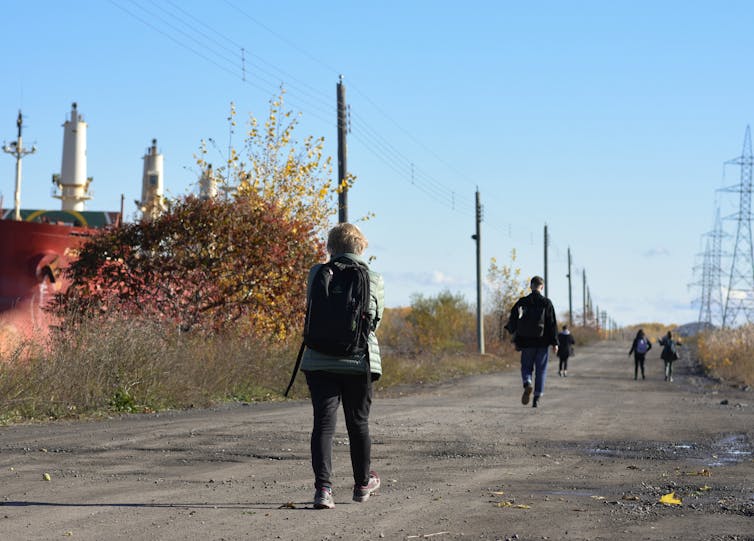
Indigenous activists have drawn attention to threatened waterways, neglected Residential School cemeteries and other social issues by walking across Land. Here a group of settlers on an Indigenous Land acknowledgment pilgrimage.
Laurence Brisson/The Concordian, Author providedMatthew Robert Anderson, Concordia University
University, religious, sports and other gatherings often begin with an Indigenous Land acknowledgement. For instance, this article was written in Montréal, or Tiohtiá:ke, on the traditional and unceded territory of the Kanien’kehá:ka (Mohawk), a place which has long served as a site of meeting and exchange amongst nations.
Land acknowledgements recognize what for some Canadians is an uncomfortable truth. These are formal statements that recognize “the unique and enduring relationship that exists between Indigenous Peoples and their traditional territories.”
On Land where territorial treaties were negotiated, the acknowledgement may use the term “traditional Lands,” and go on to specify the treaty and its number (Treaty 4, for example, includes much of southern Saskatchewan.) Land is so important that Gregory Younging — scholar, editor and author of the copyeditor’s book Indigenous Style — insisted Land be capitalized.
But when governmental and business meetings are far less likely to include acknowledgements of Indigenous Land titles, or when artistic and educational events move from initial statements to silence about their political and economic ramifications, it is hard to avoid the conclusion that such recognition is simply lip service.
What do groups mean when they say they recognize Indigenous presence, resilience and Land? And how can settler groups begin to walk the talk?
In 21 Things You Should Know About the Indian Act, author and president of Indigenous Corporate Training Bob Joseph urges Canadians to physically get out and get to know local First Nations. Ways to do this include attending Indigenous cultural or sports events or using Indigenous businesses.
As a settler academic who grew up on Treaty 4 territory, I have benefited from years of Indigenous guidance in ally-building in journey/pilgrimage studies, biblical studies and Land access. Following these learnings, I believe it is time for those of us who are not Indigenous to let our bodies learn about acknowledgement, sometimes by literally walking the talk. Properly prepared “walking acknowledgements” are one way for those of us who are non-Indigenous to demonstrate that we mean what we say about unceded and traditional territories.
This month, I led 11 students, faculty and friends on a 26-kilometre walk from Kahnawà:ke to the Department of Theological Studies at Concordia University, in Montréal, as a Territorial Acknowledgement for our Theology in the City conference. Walking helped us put our bodies where our mouths are. Those who have undertaken walking Land acknowledgements say it has both educated them and moved them away from political inaction and neutrality.
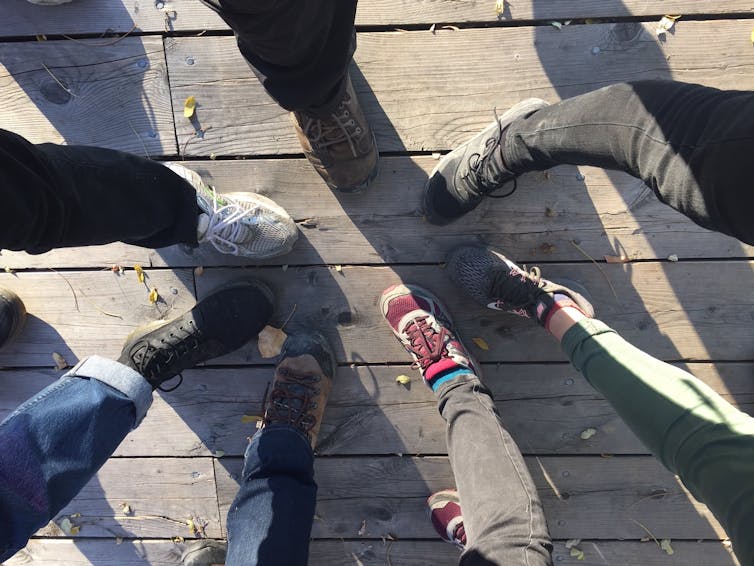
A pilgrim walk to help participants understand the true meaning of Indigenous Land acknowledgements took place last weekend in Montréal.Matthew Robert Anderson, Author provided
Showing up uninvited or unannounced is not acknowledgement. It risks being another colonial act. But with Indigenous guidance, we can physically get to know the Lands and people we are acknowledging.
These experiences help settler North Americans experience the locality and relationships that underlie most Indigenous understandings of Land. Getting to know the Land helps us learn its history — including its histories of colonization and of Indigenous resurgence. Beginning in 2014, with the guidance and permission of the Mohawk Cultural Centre of Kahnawà:ke, and the Mohawk Nation at Kahnawà:ke Longhouse, professor of theology Sara Terreault and I have led groups of students from Concordia University on four annual pilgrimages. We walked about 32 kilometres between Old Montréal, where the first French colonists built their churches and homes, and Kahnawà:ke Mohawk Territory. Some of our students had visited Kahnawà:ke before; some grew up in adjacent communities. Consistently, they reported in their project evaluations that walking the St. Lawrence Seaway, built in part on bulldozed Mohawk homes, and physically experiencing the contested border areas, and the First Nation, brought them new understandings of colonialism, economic injustice and histories of both oppression and resurgence. Atsenhaién:ton Kenneth Deer, the secretary of the Mohawk Nation at Kahnawà:ke and a working group member of the United Nations Declaration on the Rights of Indigenous Peoples, assisted us on our walk and said:
“By walking from Concordia to Kahnawà:ke or from Kahnawà:ke to Montréal you can see how close we are but a world apart.”
U.S. anthropologist Chip Colwell notes that despite the risk of token gestures, repeating Land acknowledgements offers us a chance “to confront the past while laying the groundwork for building a shared future.”
Walking through such statements helps us remember that they are both real and political, and based on Indigenous assertions of title to real places.
Acknowledgements spur us to recognize not only Land, but also commitments made in the treaties, in the United Nations Declaration on the Rights of Indigenous Peoples, or in Canada’s Truth and Reconciliation Commission’s 94 Calls to Action.
Walking all, or some part of, our Land acknowledgements gets settlers out of their silos. It can help groups experience first-hand the Land, the relationships and the Indigenous Peoples of which the Land acknowledgements speak.
But walking Land acknowledgements are only first steps toward education and consciousness-raising. They are part of the process of non-Indigenous people becoming allies through Indigenous pedagogies. Only when Land acknowledgements are fully lived out — that is, when they deepen into meaningful economic, political and cultural change, will we really be walking in the true direction of reconciliation.
[ Deep knowledge, daily.Sign up for The Conversation’s newsletter. ] Matthew Robert Anderson, Affiliate Professor, Theological Studies, Loyola College for Diversity & Sustainability; Honorary Research Fellow, University of Nottingham UK, Concordia University
This article is republished from The Conversation under a Creative Commons license. Read the original article.
Don't forget.
On July 9, 1955, Bertrand Russell and Albert Einstein, in agreement with other personalities who signed it, released this Manifesto against Nuclear bombs. It opened the antinuclear movement, that used, for the first time, the now iconic peace symbol and, acting together with other facts and political, cultural, philosophical and social changes ("from the Bomb to the Beatles"), led to the counterculture of the Sixties and the '68 rebellion.
Peace must be a given value for real civilizations, after all those years.
Please, stop the war against Kurds!
Humans never learn. My generation grew up under the daily menace of nuclear annihilation. At every moment, someone could press the red button. John Lennon said he became what he was looking at antinuke demonstrations.
Imagine people in barracks or Kurds' cities right now, or sleeping on the sides of roads to nowhere, just escaping a massacre... Wars must be banned. I want a world like that. They can keep all that technological "progress" and "disruptive" gadgets crap for themselves.
Please see https://lnkd.in/dNib7ZV as well.
There's No Room For Heaven Here - Lyrics: John Budd, - Music: Stuart Watts, 1965
The sad thing about this song is that nothing seems to have changed. Prejudice is still alive and well.
The song makes good material for an Advent meditation.