Thursday, 10 November 2022

Dulce et Decorum Est

John McCrae's wonderful poem , In Flanders Fields, is generally the poem of choice for Remembrance Day. However, it presents just one side of a valuable coin. "Dulce et Decorum Est" by Wilfrid Owen (1917) who was killed in action at the age of 25 presents the other side of that coin. 

Wilfred Owen, killed in France November 4, 1918.


(Five-Nines refers to 5.9 inch shells from German artillery fire.
"Dulce et decorum est pro patria mori" is Latin for, "Sweet and fitting it is to die for one's fatherland.)

Dulce et Decorum Est

Bent double, like of old beggars under sacks,
Knock-kneed, coughing like hags, we cursed through sludge,
Till on the haunting flares we turned our backs
And towards our distant rest began to trudge.
Men marched asleep. Many had lost their boots
But limped on, blood-shod. All went lame; all blind:
Drunk with fatigue; deaf even to the hoots
Of tired, outstripped Five-Nines that dropped behind.

Gas! Gas! Quick, boys!- An ecstasy of fumbling,
Fitting the clumsy helmets just in time;
But someone still was yelling out and stumbling,
And flound’ring like a man in fire or lime…
Dim, through the misty panes and thick green light,
As under a green sea, I saw him drowning.

In all my dreams, before my helpless sight,
He plunges at me, guttering, choking, drowning.

If in sonic smothering dreams you too could pace
Behind the wagon that we flung him in,
And watch the white eyes writhing in his face,
His hanging face, like a devil’s sick of sin;
If you could hear, at every jolt, the blood
Come gargling from the froth-corrupted lungs,
Obscene as cancer, bitter as the cud
Of vile, incurable sores on innocent tongues,-
My friend, you would not talk with such high zest
To children ardent for some desperate glory,
The old Lie: Dulce et decorum est
Pro patria mori.

Saturday, 23 July 2022

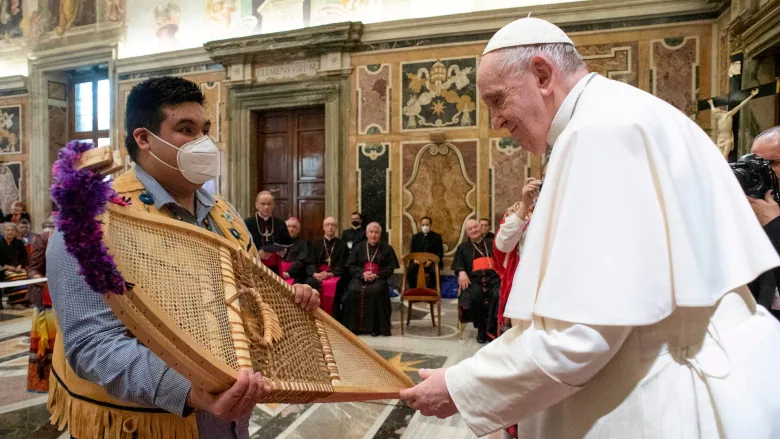
Anticipated Papal Apology - Canada 2022


Image credit: https://i.cbc.ca

Different people have emphasised different elements and narratives if the coming, long awaited apology from Pope Francis this month of July, 2022, is to have any hope of acceptance from Indigenous Peoples in Canada, and especially from survivors and others impacted by forced residential schooling which the Catholic Church so enthusiastically and vigorously implemented on behalf of the Canadian Government in the nineteenth and twentieth centuries; even before we get to recalling the sexual and other abuses that went on for so long and were covered up by complicit hierarchy for decade after decade.

The 'apology' will surely be comprised of the entire pontifical visit, from landing to takeoff, and not just the 'words of institution', as it were.

I am of the opinion that the Catholic residential schools debacle is just one, albeit a very major one, of many 'sins' for which the Catholic Church needs to publicly repent. Consider all the unjust wars, slavery, persecutions, murders, rapes, pillage, theft and imperialistic colonizing that took place subsequent to, and enabled and condoned by what is now called The Doctrine of Discovery. If you don't know what this is, or to refresh your memory, please see this one or two minute read: https://doctrineofdiscovery.org/dum-diversas/

For those who think that sincere and humble words should be enough, consider the following story from Father Mxolisi Mpambani told by Antjie Krog in Chapter 10 of her book, Country of my Skull, which deals with the South African Truth and Reconciliation Commission post apartheid.

Once there were two boys, Tom and Bernard. Tom lived right opposite Bernard. One day Tom stole Bernard's bicycle and every day Bernard saw Tom cycling to school on it. After a year, Tom went up to Bernard, stretched out his hand and said, "Let us reconcile and put the past behind us."

Bernard looked at Tom's hand. "And what about the bicycle?"

"No," said Tom, "I'm not talking about the bicycle - I'm talking about reconciliation."


True reconciliation requires remorse, repentance, restitution, reparation, reform, unbounded respect, and acceptance of the fact that forgiveness might still not be forthcoming in our lifetime.

Friday, 27 August 2021

For Catholics, are the laity really boss of the environment?

Image: https://www.newsecuritybeat.org/2016/01/paris-whats-status-environmental-refugees/

Pope Francis has written an amazing encyclical on The Care of Our Common Home - Laudato 'Si. In it he points out that care for the environment, and care for the people most vulnerable to the ravages of climate change, are two sides of the same coin. Although it is the Pope who has taken the lead in melding the best of theology and science to produce this social encyclical, the laity have the principal role in putting that care into practice - this according to the Vatican II Dogmatic Constitution on the Church, Lumen Gentium, paragraph 36...

"36... The faithful, therefore, must learn the deepest meaning and the value of all creation, as well as its role in the harmonious praise of God. They must assist each other to live holier lives even in their daily occupations. In this way the world may be permeated by the spirit of Christ and it may more effectively fulfill its purpose in justice, charity and peace. THE LAITY HAVE THE PRINCIPAL ROLE IN THE OVERALL FULFILLMENT OF THIS DUTY. Therefore, by their competence in secular training and by their activity, elevated from within by the grace of Christ, let them vigorously contribute their effort, so that created goods may be perfected by human labor, technical skill and civic culture for the benefit of all men according to the design of the Creator and the light of His Word. MAY THE GOODS OF THIS WORLD BE MORE EQUITABLY DISTRIBUTED AMONG ALL MEN, and may they in their own way be conducive to universal progress in human and Christian freedom. In this manner, through the members of the Church, will Christ progressively illumine the whole of human society with His saving light."

So, that all sounds wonderful, but it begs a few questions: How do we do this caring - for the environment and the environmentally vulnerable, especially environmental refugees? How important is this in the grand scheme of our daily lives and other responsibilities? How do we generate enthusiasm for the cause? In short, how do we make a difference? AND... How does accountability work?

Saturday, 31 July 2021

What is clericalism? This is clericalism.


Image: https://www.cbc.ca/news/canada/manitoba/rheal-forest-residential-schools-1.6121886

Winnipeg Catholic priest accuses residential school survivors of lying about abuse for money

Why did I not read anywhere about the congregation walking out during this 'sermon'. Silence will be construed as assent. When are lay Catholics going to take a stand against clericalism? I hear many Catholics today objecting to being tarred with the brush of what happened 'historically', but silence in the face of 'sermons' like this makes us complicit.

So, what makes this clericalism?

I see this as a classic case:
1) a member of the clerical hierarchy is defending the clerical institution;
2) doing so from a position of institutional authority, namely the pulpit, during the Sunday liturgy over which he presides;
3) he exonerates the priests and nuns;
4) he blames the lay workers;
5) he trivializes any abuse as to be expected in "any institution";
6) he shows not one drop of empathy for victims;
7) he accuses victims of lying to get more money;
8) he angrily accuses "the media" of propagating "fake news";
9) according to the CBC article, the only other outrage he expresses is toward vandals who paint graffiti on a church building.

Any single one of these constitutes clericalism. To get so many in one event is quite an achievement.

In disavowing and apologizing for the priest's statements, the Archdiocesan spokesperson said, "We very much regret the pain they may have caused to many people..." MAY have caused? How polite! Why not, "they obviously MUST have caused...?"

The first and immediate response from the archdiocese was damage control: a polite apology, and preventing this priest from making any further public statements. And that is how it will be perceived and what will be remembered: damage control for the sake of the institutional church.

What about the victims? A subsequent statement from the Archbishop did acknowledge the victims, but by then the damage had been done and the clericalism exposed.

How many steps forward and how many steps backward?

Saturday, 24 July 2021

The scandalous minutiae of clericalism


The other day, the first reading for mass of the day was the giving of the "Ten" Commandments from Exodus. I was reminded of a day-dreaming moment in class in grade 9 (who knows what subject?) when I wondered why God decided upon THOSE ten commandments. Testosterone driven, I considered how much more fun and how much less guilt I would have if certain commandments simply weren't there. In my understanding, the Ten Commandments were arbitrarily decided upon by an all powerful God. And then there was the Church: the priest and catechism teachers who put an even stricter interpretation on an already restrictive set of "Thou shalt not's".

It was not until adult years that I came to appreciate the beauty and desirability of the Ten Commandments in terms of love, happiness and the Two Great Commandments phrased by Jesus. But the more I have grown in that appreciation, the more I have been confounded and frustrated by certain people in the Catholic Church (clerics and laity) who appear preoccupied with the minutiae of "churchy" stuff that sometimes appears to run counter to Christ's Law of Love. I think of issues such as the "correct" way of celebrating the sacraments, Latin or vernacular language, the role of women in the Church, the place of LGBTQ+ Christians, Pro-Life versus pro-life issues. Then there are the scandals that have been met with defensiveness instead of humble acknowledgement and repentance: the scandal of child sexual abuse over a century or more by priests and other Church representatives and, more recently, the freshly resurrected scandal of the Catholic Church's role with Indian Residential Schools.

From boyhood through to adulthood I was taught to defer to the priests in everything concerning doctrine, faith and spiritual practice because the priests knew best , having spent 7 years or more studying theology. Prior to Vatican II lay people were discouraged from reading the Bible because "only the priest knew" the correct way to interpret the Sacred Scriptures. These are the hallmarks of clericalism - defined as "an expectation, leading to abuses of power, that ordained ministers are better than and should be over everyone else among the People of God." 

In the past, bishops saw avoiding scandal as taking priority over protecting victims of abuse by priests. This was blatant clericalism and ultimately resulted in even greater scandal. Clericalism still happens today, in my opinion, when Catholics, lay or clergy, become defensive over the role of the Church in the Residential School scandal, when we hasten to point out that other denominations also ran residential schools, that it was a government program, that not all the graves are those of children, that most of the children likely died of disease such as tuberculosis, that "the pope has already apologised." Clericalism is defensive and ultimately arrogant and self-serving. Its defeat has to include humble acknowledgement, repentance and restitution.

Fortunately the Holy Spirit is God's self-giving gift to the whole Church - not just the clergy. Fortunately, also, we have a pope who is calling everyone, clergy and laity, to take a stand against clericalism.