So, here is my
question: Are there or are
there not provincial or federal laws or regulations prohibiting the release
ofcommercial and industrial waste and,
especially, raw sewage into the rivers of Canada or, at least, the rivers and
aquifers of Ontario?
If not, why not? If
yes, how are they enforced?
I ask after being
shocked to read the following article in Global News:
Oneida Nation of the Thames tap water different than
neighbouring non-Indigenous communities
Particularly
disturbing are the following three paragraphs:
"18 years of
water quality testing across Oneida First Nation sometimes shows striking
levels of dangerous pathogens such as E. coli flowing from residential taps. Upstream, the nearby city of London dumps millions of
litres of raw sewage into the Thames River that serves as the
community’s water source…"
"The Thames
River, which replenishes Oneida’s aquifer, is a dumping ground for waste, raw
sewage and pollution. To avoid basement flooding during heavy rains, London’s wastewater system dumps rainwater and raw
sewage into the river. In 2018, 266 million litres of raw sewage was
released and flowed downstream through several First Nations communities,
including Oneida.
"So far this year, more than 5.7 million litres of
London’s raw, untreated sewage — including commercial and industrial waste —
has been dumped into the river, according to city data.
London didn’t start
notifying Oneida of sewage dumps until mid-2018, say Oneida leaders, including
Chief Hill. Even then, Oneida is only notified after the dump has occurred,
sometimes hours or days later."
Here, again, is my
question: Are there or are
there not provincial or federal laws or regulations prohibiting the release
ofcommercial and industrial waste and,
especially, raw sewage into the rivers of Canada or, at least, the rivers and
aquifers of Ontario?
If not, why not? If yes, how are they enforced?
I realise that the
question is rhetorical. Doing just 2 minutes of searching on the Internet I
found that:
raw
sewage overflowed into southern Ontario waterways 1,327 times in the 12 months
ending March, 2018;
the
city of Toronto releases more than 1-billion litres of
raw sewage into Lake Ontario in a single day;
when
excessive stormwater has nowhere to escape, it funnels into sewers causing them
to overflow and spill untreated contents into lakes or rivers;
there are
provincial regulations but they are full of loopholes circumventing
enforcement.
I have
been following a Facebook group focusing on drinking water and other water
availability issues in South Africa. They regularly bemoan the fact that, due
to aging infrastructure, neglect and poor accountability, raw sewage is spilling into some of the dams sourced
for drinking water. I have been feeling lucky to be living in Canada - a First World
country after all. How presumptuous and arrogant of me.
A friend who knows I'm a climate change nut challenged me, asking my thoughts on a rather scathing newspaper op-ed. My response follows.
We have a climate crisis of global warming that requires urgent attention. I say this with confidence because it is not merely my opinion, or anyone else's opinion, but a fact established with evidence from science and attested to by climate scientists worldwide. This according to NASA, the National Aeronautics and Space Administration of the USA. (See https://climate.nasa.gov/evidence/)
Along with the global warming issue we have serious problems with air pollution that are having devastating effects upon vulnerable people whose lungs and breathing ability are already compromised, as well as people with cardio-vascular illnesses. We can only guess how much impact this is also having on childhood development, or life expectancy in the elderly. See, for instance: https://www.canada.ca/en/health-canada/services/air-quality/health-effects-indoor-air-pollution.html
Thirdly, there is the contribution that environmental issues make to the "refugee crisis" that we hear so much about and feel the need to 'control' without thinking about controlling the causes of environmental degradation which is very much a root cause of migration for environmental refugees. According to Pope Francis: “Climate change is also contributing to the heart-rending refugee crisis. The world’s poor, though least responsible for climate change, are most vulnerable and already suffering its impact.” https://www.independent.co.uk/news/people/pope-francis-climate-change-environment-refugee-crisis-destroy-sin-a7221476.html
What to do?
First of all, what NOT to do! I honestly do not think it is at all helpful when people look at their neighbours in countries that are oceans and continents away, or just a province or two away, or "on the reserve", and point out that, since THEY are contributing so significantly to the problem, what is the point of politicians trying to force ME to make sacrifices - as with a carbon 'tax'? As I see it, that line of reasoning lets us all off the hook of sacrifice. Not only can we just leave the problem, then, for our grandchildren to solve but we can feel free to continue exacerbating the problem by pushing out limitless pollutants seeing as our contribution is so small - relatively speaking.
The other thing NOT to do is give greater credibility to politicians and economists and their populist journalist followers (left, right and centre) than the credibility we afford climate scientists. It is inexcusable that government bureaucrats implement environmental policy changes without consulting scientists. More inexcusable is when governments then gag their own publicly funded scientists and not allow them to publish their peer-reviewed research.
I use gasoline to drive my car. I would love to be driven in a clean-energy taxi. I use liquid natural gas to warm my house. (As I write, the temperature today has warmed up to a high of +2C - the highest it has been in the last 5 days.) I would love to warm my house with power from the sun or wind, but our local government cancelled, at great expense in penalties, the renewable energy program initiated by the previous local government. My point is that there are some initiatives that cannot be undertaken by individuals without incurring prohibitive personal expense. Such initiatives require changes to infrastructure that can only be achieved by local and national governments. But the will has to be there. As I see it, partisan political loyalties, fueled by the things NOT to do that I describe above, are the major obstacles to people even seeing the need, let alone developing the socio-political will.
Let's get off the darkness band-wagon and switch on an LED candle, and try to influence the people around us to do the same. "Lord, make me an instrument of your peace... "
Learning the Land: Walking the talk of Indigenous Land acknowledgements
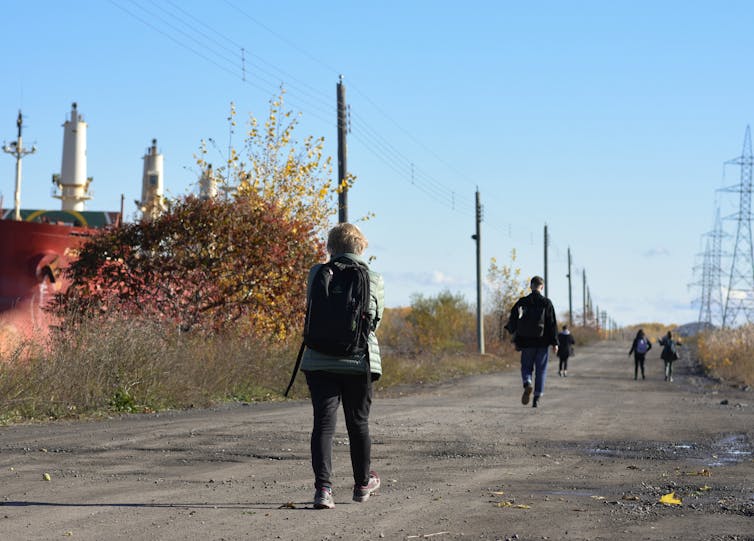
Indigenous activists have drawn attention to threatened waterways, neglected Residential School cemeteries and other social issues by walking across Land. Here a group of settlers on an Indigenous Land acknowledgment pilgrimage.
Laurence Brisson/The Concordian, Author providedMatthew Robert Anderson, Concordia University
University, religious, sports and other gatherings often begin with an Indigenous Land acknowledgement. For instance, this article was written in Montréal, or Tiohtiá:ke, on the traditional and unceded territory of the Kanien’kehá:ka (Mohawk), a place which has long served as a site of meeting and exchange amongst nations.
Land acknowledgements recognize what for some Canadians is an uncomfortable truth. These are formal statements that recognize “the unique and enduring relationship that exists between Indigenous Peoples and their traditional territories.”
On Land where territorial treaties were negotiated, the acknowledgement may use the term “traditional Lands,” and go on to specify the treaty and its number (Treaty 4, for example, includes much of southern Saskatchewan.) Land is so important that Gregory Younging — scholar, editor and author of the copyeditor’s book Indigenous Style — insisted Land be capitalized.
But when governmental and business meetings are far less likely to include acknowledgements of Indigenous Land titles, or when artistic and educational events move from initial statements to silence about their political and economic ramifications, it is hard to avoid the conclusion that such recognition is simply lip service.
What do groups mean when they say they recognize Indigenous presence, resilience and Land? And how can settler groups begin to walk the talk?
In 21 Things You Should Know About the Indian Act, author and president of Indigenous Corporate Training Bob Joseph urges Canadians to physically get out and get to know local First Nations. Ways to do this include attending Indigenous cultural or sports events or using Indigenous businesses.
As a settler academic who grew up on Treaty 4 territory, I have benefited from years of Indigenous guidance in ally-building in journey/pilgrimage studies, biblical studies and Land access. Following these learnings, I believe it is time for those of us who are not Indigenous to let our bodies learn about acknowledgement, sometimes by literally walking the talk. Properly prepared “walking acknowledgements” are one way for those of us who are non-Indigenous to demonstrate that we mean what we say about unceded and traditional territories.
This month, I led 11 students, faculty and friends on a 26-kilometre walk from Kahnawà:ke to the Department of Theological Studies at Concordia University, in Montréal, as a Territorial Acknowledgement for our Theology in the City conference. Walking helped us put our bodies where our mouths are. Those who have undertaken walking Land acknowledgements say it has both educated them and moved them away from political inaction and neutrality.
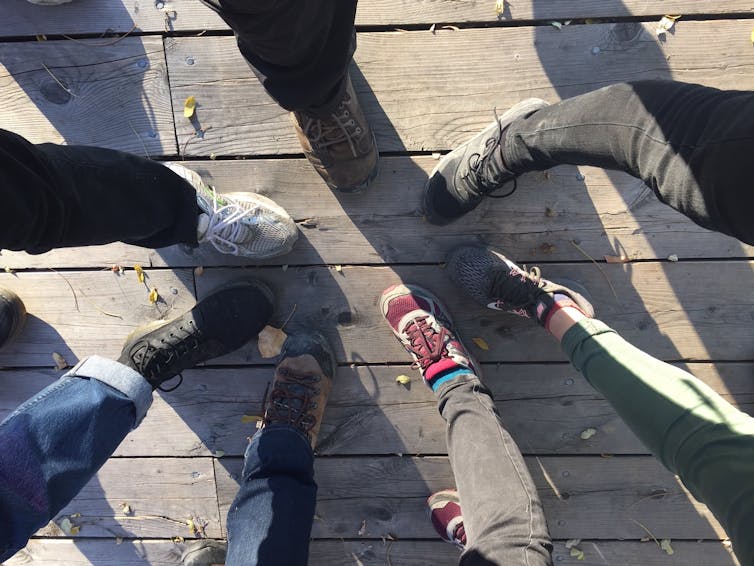
A pilgrim walk to help participants understand the true meaning of Indigenous Land acknowledgements took place last weekend in Montréal.Matthew Robert Anderson, Author provided
Showing up uninvited or unannounced is not acknowledgement. It risks being another colonial act. But with Indigenous guidance, we can physically get to know the Lands and people we are acknowledging.
These experiences help settler North Americans experience the locality and relationships that underlie most Indigenous understandings of Land. Getting to know the Land helps us learn its history — including its histories of colonization and of Indigenous resurgence. Beginning in 2014, with the guidance and permission of the Mohawk Cultural Centre of Kahnawà:ke, and the Mohawk Nation at Kahnawà:ke Longhouse, professor of theology Sara Terreault and I have led groups of students from Concordia University on four annual pilgrimages. We walked about 32 kilometres between Old Montréal, where the first French colonists built their churches and homes, and Kahnawà:ke Mohawk Territory. Some of our students had visited Kahnawà:ke before; some grew up in adjacent communities. Consistently, they reported in their project evaluations that walking the St. Lawrence Seaway, built in part on bulldozed Mohawk homes, and physically experiencing the contested border areas, and the First Nation, brought them new understandings of colonialism, economic injustice and histories of both oppression and resurgence. Atsenhaién:ton Kenneth Deer, the secretary of the Mohawk Nation at Kahnawà:ke and a working group member of the United Nations Declaration on the Rights of Indigenous Peoples, assisted us on our walk and said:
“By walking from Concordia to Kahnawà:ke or from Kahnawà:ke to Montréal you can see how close we are but a world apart.”
U.S. anthropologist Chip Colwell notes that despite the risk of token gestures, repeating Land acknowledgements offers us a chance “to confront the past while laying the groundwork for building a shared future.”
Walking through such statements helps us remember that they are both real and political, and based on Indigenous assertions of title to real places.
Acknowledgements spur us to recognize not only Land, but also commitments made in the treaties, in the United Nations Declaration on the Rights of Indigenous Peoples, or in Canada’s Truth and Reconciliation Commission’s 94 Calls to Action.
Walking all, or some part of, our Land acknowledgements gets settlers out of their silos. It can help groups experience first-hand the Land, the relationships and the Indigenous Peoples of which the Land acknowledgements speak.
But walking Land acknowledgements are only first steps toward education and consciousness-raising. They are part of the process of non-Indigenous people becoming allies through Indigenous pedagogies. Only when Land acknowledgements are fully lived out — that is, when they deepen into meaningful economic, political and cultural change, will we really be walking in the true direction of reconciliation.
[ Deep knowledge, daily.Sign up for The Conversation’s newsletter. ] Matthew Robert Anderson, Affiliate Professor, Theological Studies, Loyola College for Diversity & Sustainability; Honorary Research Fellow, University of Nottingham UK, Concordia University
This article is republished from The Conversation under a Creative Commons license. Read the original article.
Don't forget.
On July 9, 1955, Bertrand Russell and Albert Einstein, in agreement with other personalities who signed it, released this Manifesto against Nuclear bombs. It opened the antinuclear movement, that used, for the first time, the now iconic peace symbol and, acting together with other facts and political, cultural, philosophical and social changes ("from the Bomb to the Beatles"), led to the counterculture of the Sixties and the '68 rebellion.
Peace must be a given value for real civilizations, after all those years.
Please, stop the war against Kurds!
Humans never learn. My generation grew up under the daily menace of nuclear annihilation. At every moment, someone could press the red button. John Lennon said he became what he was looking at antinuke demonstrations.
Imagine people in barracks or Kurds' cities right now, or sleeping on the sides of roads to nowhere, just escaping a massacre... Wars must be banned. I want a world like that. They can keep all that technological "progress" and "disruptive" gadgets crap for themselves.
Please see https://lnkd.in/dNib7ZV as well.
In 2019 Canadians voted overwhelmingly for profits and economic growth over the sustainability of the environment, in defiance of the evidence of science and climate change, and the marching of our children. History and our grandchildren will judge us.
The Paris Agreement's long-term temperature goal is to keep the increase in global average temperature to well below 2 °C above pre-industrial levels; and to pursue efforts to limit the increase to 1.5 °C. This requires countries to cut emissions by 45% by 2030, end fossil fuel subsidies and ban new coal plants after 2020. Most of our parties talk about "reducing" carbon emissions but do not set goals to cut emissions by 45% by 2030.
The Conservative Party climate plan has been almost universally panned by experts for failing to have any reasonable chance of achieving the weak 2030 emissions targets the Harper government set. It is as good as no plan, which is a plan to fail.
Although better than the Cons, the Liberal climate plan is to reduce our emissions by 30% by 2030, compared to 2005 levels. This falls way short and is a plan to fail.
The NDP talk about achieving targets in line with scientific consensus. This definitely sounds better than the Liberals but they support new fossil fuel projects which will make achieving the goal impossible.
The Green Party has the most aggressive plan which clearly heeds the UN’s call for rapid and transformative changes to Canadian society. The plan has faced criticisms for being unrealistic in scope and speed, but there is broad consensus that it would exceed emissions targets if implemented.
If you still don't understand, ask 16 year old Greta Thurman to explain. She gets it.